Projects
Bathroom or wet room
A bathroom refit and a tanked wet room sit at opposite ends of the same job: strip-out, waterproofing, tiling and fittings, handled end to end with the rest of the home sealed off from the dust. Here is what a job of this kind actually involves, what moves the cost, and the lease details that matter in London flats.
- Bathroom refit
- Tanked wet room
- Waterproofing & tiling
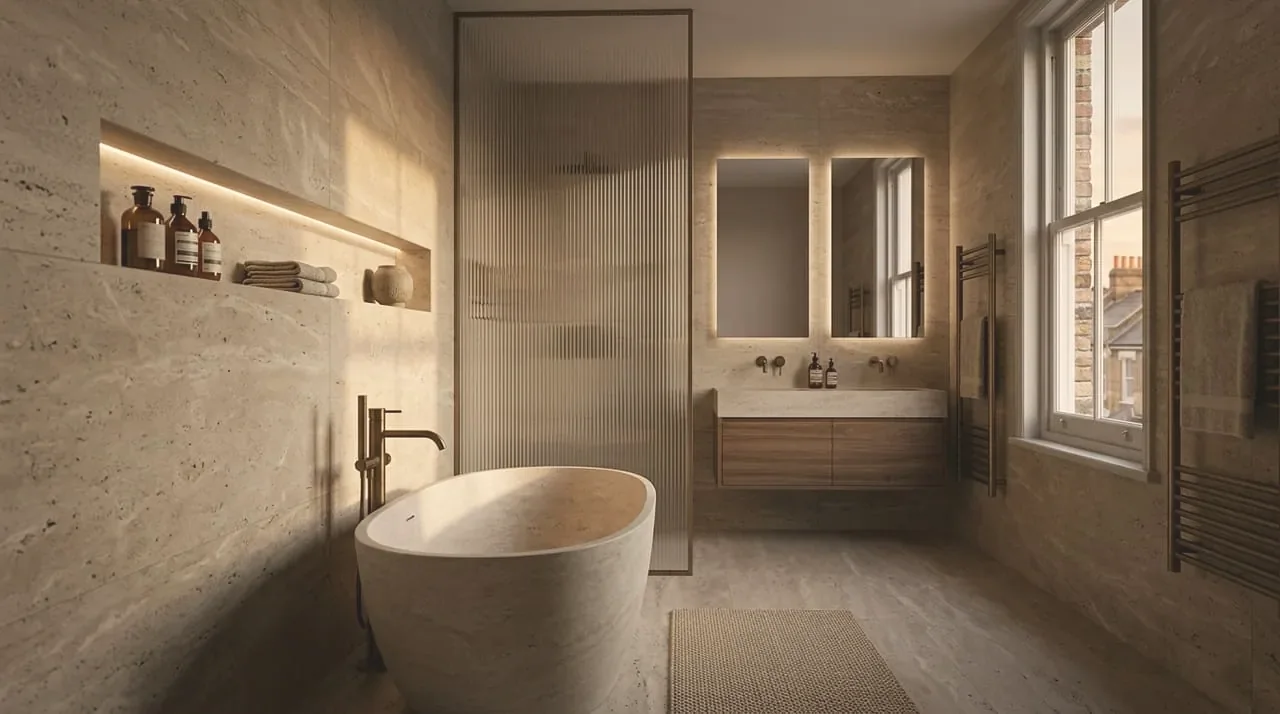
A bathroom refit and a tanked wet room sit at opposite ends of the same job — strip-out, waterproofing, tiling and fittings — handled end to end, with the rest of the home sealed off from the dust. This page walks through what a typical job of this kind actually involves, what moves the cost, and the lease and waterproofing details that matter most in London flats.
Bathroom renovation and wet room installation across London
A standard bathroom refit — strip out the old sanitaryware, relay the waterproofing, tile the walls and floor, fit a new suite and reconnect the plumbing — typically runs £11,000–£22,000 in London. A full wet room with a level-access shower, tanked walls, electric underfloor heating and stone or large-format tiling sits closer to £27,000–£49,000+. On a typical job of this kind the itemised price is set before a single tile is ordered, and the start date and finish date are confirmed in writing before work begins.
What a bathroom refit or wet room involves
Most bathroom renovations cover the same core stages, whether you are fitting a walk-in shower into an existing bathroom or converting the whole room to a level-access wet room:
- Strip-out and first-fix plumbing. Remove the existing suite, cap unused supplies, run new waste and supply lines to the agreed positions.
- Tanking / waterproofing. For wet rooms, and for tiled shower areas in standard bathrooms, the substrate gets a full tanked membrane — walls and floor — bonded before a single tile goes down. This is what stops water migrating through the screed and damaging the floor below, which matters especially in flats.
- Screeding to falls. Wet-room floors are laid to drain correctly toward the waste; the fall is set at the screed stage, not tiled over later.
- Tiling. Walls and floor tiled to the agreed layout — large-format porcelain, stone, metro, mosaic — grout colour chosen and confirmed before work begins.
- Second-fix fittings. Sanitaryware, shower enclosure or frameless glass panel, basin, WC, towel rail and accessories fitted and sealed.
- Underfloor heating (where specified). Electric mat or wet system laid beneath the tiled floor, wired or plumbed to the agreed controls.
- Heated towel rail / boiler tie-in. Any connection to the central heating circuit is carried out by a qualified gas or heating engineer on the team.
- Ventilation. Extraction upgraded where required — standard requirement in rooms with no openable window.
Flats: waterproofing and lease considerations
For bathroom work in mansion-block flats and period conversions — common across Maida Vale (W9), Bayswater (W2), South Kensington (SW7), Pimlico (SW1V), Belgravia (SW1X) and Earl's Court (SW5) — two things matter beyond the tiling itself, and both feed into wider flat renovation planning.
First, the floor below. A wet room in a first-floor flat is directly above someone else's ceiling. The tanking system has to be continuous, correctly bonded at every angle and junction, and inspected before the tiles go down. On a typical job of this kind the tanking stage is photographed before tiling; that record protects both the flat owner above and the neighbour below.
Second, freeholder and lease sign-off. Most long leases require the freeholder's consent before you alter drainage, plumbing or structural elements. Some leases specify a minimum tile or acoustic underlay spec. Both are best flagged at survey stage — it is better to know before ordering materials than after.
What drives the cost and the programme
Three factors move the number on a bathroom renovation or wet room installation in London more than anything else:
- The extent of the plumbing move. Keeping the suite in its existing footprint is faster and cheaper. Relocating the soil stack or moving the WC to a new wall adds time and cost for both the building work and any building control notification.
- The tile and sanitary specification. Porcelain to a standard format versus natural stone at 600×1200 is a material-cost multiplier; the latter also needs a more robust substrate and careful handling. Fully frameless glass panels cost more than framed screens.
- Whether it is a first or second bathroom. In a home with only one bathroom, sequencing matters — a job of this kind is planned so you are not without a WC for more than a single overnight, and in most cases you keep access to a basin and shower throughout.
Programme for a standard bathroom refit: 2–3 weeks on site. A larger wet-room conversion with full replumbing: 3–5 weeks.
Where PSS does this work
PSS carries out bathroom renovations and wet room installations across Greater London and the Home Counties. The high-spec end of the market — period houses, mansion-block flats, converted lateral apartments — is concentrated in Westminster and the Royal Borough of Kensington & Chelsea. That means a lot of bathroom work falls in areas like Maida Vale, Bayswater, South Kensington, Earl's Court, Pimlico and Belgravia, as well as Marylebone and the wider Zones 1–3 belt. Coverage extends across all of Greater London and out into the Home Counties — if you are unsure whether your address is in range, request an estimate and it can be confirmed.
Get a price
Request an estimate online. The site is visited, measurements taken, any lease or freeholder requirements confirmed, and a written, itemised quote follows — with no obligation to proceed.
Related
This is an example of the kind of work we take on, not a specific completed job. Photographed, signed-off projects live in the gallery. Every job starts with a free site visit and a written, itemised quote.