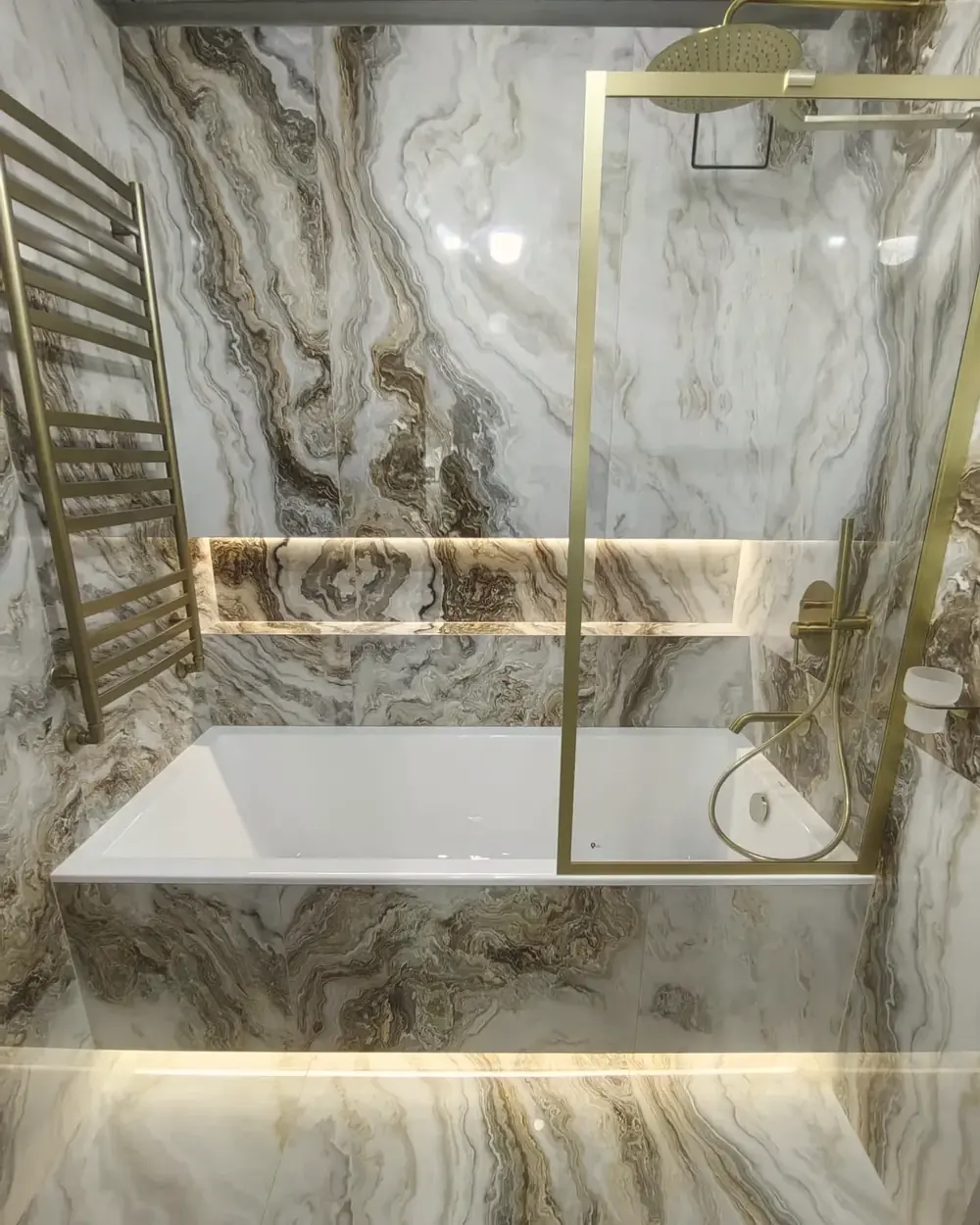
Wet room vs walk-in shower in London (2026): which is right for your bathroom?
A wet room and a walk-in shower are different projects with different risks. Which suits your room and floor, and the waterproofing.

A wet room and a walk-in shower look similar in a brochure but are very different builds with very different risks, and the right choice depends on your room, your household and what's under the floor. A walk-in shower keeps a tray (or a kerbed tiled floor) and a glass panel, with the rest of the bathroom kept dry; it costs less and carries less risk. A wet room tanks and falls the whole floor to a drain, loses the tray entirely, looks seamless and saves space — but it only works if the waterproofing is faultless. In London, expect roughly £3,600–£7,800 for a walk-in as part of a bathroom and £6,600–£14,500 for a wet room. This guide is a suitability matrix: who each is genuinely for, what each costs, and why the waterproofing is the decision that matters most.
The plain difference
Set side by side: a walk-in shower is an open-fronted bay using either a low-profile tray or a tiled floor set within a shallow kerb, closed by a fixed glass screen — the shower is contained and the rest of the room stays dry underfoot. A wet room has no tray and no kerb; the entire floor is waterproofed beneath the tiles, graded so water runs to a single drain, and the shower simply occupies one part of an open, tiled space. In a wet room, water reaching the rest of the floor is fine, because the whole floor is built to handle it. That one structural difference drives everything else — cost, risk, and where each one belongs.
Who a wet room is genuinely for
A wet room earns its place in specific situations:
- A small bathroom, under roughly 3.5 m². Losing the tray and the cubicle physically recovers floor space, and an open wet floor makes a tight room feel a size larger.
- A bathroom you want to future-proof. Level-access by design, it suits ageing in place and genuine accessibility far better than a stepped tray.
- A clean, minimal design brief, where a continuous tiled floor with no tray edge is the look you're after.
- A solid, rigid subfloor — a concrete slab or properly stiffened joists — because the waterproofing depends on a base that won't flex.
- An owner who'll keep on top of it. More grout means more cleaning, and a squeegee becomes part of the daily routine.
Who's better off with a walk-in shower
For a large share of London homes, the walk-in is the smarter call:
- The only bathroom in a busy household. With children, bathing, and multiple users, a contained shower and a separate dry floor is simply more practical day to day.
- A flat sitting above other homes. A wet room done well is fully watertight — but a wet room done badly is a disaster for the flat below, and a kerbed tray with a screen is the lower-risk build.
- A mainstream resale market. A great many London buyers still want a bath in the home somewhere; a walk-in leaves room for one, whereas a wet room often takes its place.
- A timber-floored loft or extension. Most timber floors flex, and even slight movement can crack a tanking seal — over timber, a wet room is wise only once an engineer confirms the deck is rigid enough and a proper sheet-membrane system goes in.
The waterproofing is the whole decision
Here's the part that should drive your choice, not the aesthetics. A real wet room has three layers of protection beneath the tiles: a waterproofing membrane — liquid or sheet, from systems like Kerdi, Wedi or BAL — across the full floor and well up every wall the water can reach; sealed joints at every corner and pipe penetration; and a built-in fall to the drain, usually no shallower than about 1:80, formed with a pre-sloped former rather than guessed by eye. Budget £1,800–£3,600 for the tanking alone, on top of the tiling — and treat any wet-room quote noticeably cheaper than that as one that's leaving a layer out. The reason this matters so much: when a wet room lets water down into the home beneath, putting it right can run to £15,000–£50,000, never mind the relationship with the neighbour. The waterproofing isn't a detail; it's the product.
Drains, and the finish they give
The drain you choose changes both the look and the install. A central square gully is the simplest and cheapest, but it's the hardest to keep looking clean and forces falls from four directions into one point. A linear channel (Impey, Geberit and similar) costs more and is more involved to set — the floor falls toward a single line — but it reads far better, and with a tileable insert it all but vanishes into a continuous tiled plane. A wall-line drain is the cleanest look of all, with the floor running to a slot at the base of one wall, though it's the least common. For a premium finish, a tile-insert linear channel is usually the one to specify.
The middle path most London bathrooms should take
There's a third option that gets overlooked, and it's the right answer more often than either extreme: a tanked, drained shower zone built inside an otherwise conventional bathroom. You get the wet-room look exactly where it counts — no tray, no kerb, the walls and floor of the shower flowing together — while the rest of the room stays a normal, dry bathroom with the bath and the basin where you'd expect. The risk is contained to the shower area, the cost is lower than a full wet room, and the look is most of the way there. For a typical London family bathroom, this part-wet-zone is the build we'd point most people toward.
Closing CTA
The wet-room-or-walk-in question is really a question about your floor, your household and your appetite for risk — and it's best answered on site, looking at the subfloor and the room. PrimeCraft Surface Solutions checks the structure, recommends the build that fits how you actually live, and prices the tanking as its own clear line so you can see what the waterproofing costs — across London and the home counties surrounding it. Arrange a free bathroom survey, or read the full bathroom renovation cost guide, and we'll tell you which of the three is right for your room.