Wet Room & Bathroom Costs in Chigwell, Loughton & Essex (2026)
Bathroom renovation and wet room costs across Chigwell, Loughton and the IG postcodes — roughly £11,000 to £49,000+, each figure fixed and itemised at survey.
The bathrooms that come out of Chigwell, Loughton, Buckhurst Hill and the wider IG postcodes tend to share a starting point: a solid inter-war house with a small, dated room that was never planned around the way the family now lives. Across this Epping Forest corridor a bathroom renovation in 2026 lands somewhere between about £11,000 for a clean like-for-like refresh and £49,000+ for a fully design-led scheme, and where you fall inside that spread is decided far less by your postcode than by the room itself — its size, whether the layout moves, the finish you choose, and what the strip-out uncovers behind fifty-year-old plaster. This guide is written for the housing stock out here specifically: why these homes ask for the briefs they do, where a wet room earns its place, what an older Essex semi tends to hide, and the real numbers to plan around before anyone measures up.
Why the housing stock out here shapes the brief
Drive the streets around Chigwell, Buckhurst Hill and Loughton and a pattern repeats itself: bay-fronted 1930s and 1940s semis, pockets of earlier Edwardian terracing nearer Ilford, and larger inter-war detached houses on the deeper plots toward the forest. It is well-built stock, but it was built for a different life. Almost all of these homes started with a single bathroom — often squeezed over the hall or above the kitchen — sized for a household that bathed rather than showered, with no thought of an en suite or a second WC.
Two things follow from that. First, the original room is usually small and awkwardly proportioned, so much of the work here is about winning usable space rather than simply swapping a suite for a newer one. Second, demand for a private, second bathroom is strong: an en suite in Loughton or Buckhurst Hill is often carved from a corner of a main bedroom or a redundant box room, which quietly turns a straightforward refit into a small reconfiguration with its own plumbing run. Naming which of those two jobs you are actually taking on is the first step to a number you can trust.
Wet room or walk-in shower for these floorplans
That tight footprint is exactly why the wet room question comes up so often in these houses. Losing the tray and the kerb makes a small room read larger and gives a level, step-free floor that suits an ageing household and a young family equally well. But a wet room and a walk-in shower are genuinely different builds carrying different risks, and rather than repeat the full decision here we have set it out — who each suits, the waterproofing, and the cost gap — in our guide to wet rooms versus walk-in showers.
The short version for this stock: a proper wet room installation in Essex works beautifully in these semis, provided the floor is right. On a solid ground floor it is straightforward. On a suspended timber floor — which most first-floor bathrooms here sit on — the joists have to be sound and stiff before the whole area is tanked, because any flex will crack the waterproof membrane. When a homeowner in Buckhurst Hill asks about a wet room in an upstairs bathroom, checking that floor is the first thing we do. Where the timber will not hold still, a tanked walk-in shower set inside an otherwise conventional bathroom gives most of the seamless look with far less exposure.
What a strip-out uncovers in an older Essex semi
No two strip-outs are identical, but in inter-war and period homes the same short list of finds recurs, and naming them before the survey is far cheaper than meeting them mid-job:
- Lead supply pipes. The incoming main in many of these houses is dull-grey lead that marks under a thumbnail. Replacing the homeowner's side in copper or MDPE is a modest job, and a bathroom strip-out is the natural moment to do it.
- Tired waste runs. Original waste and soil connections are often undersized, poorly fallen or part-collapsed. If the WC or basin is moving even slightly, the run usually wants renewing rather than reconnecting.
- Joist condition. A stone-resin or cast-iron bath, or a screeded wet-room floor, can ask more of the joists than they were built to carry. Doubling them up is a straightforward decision once the floor is open.
- Extraction. A surprising number of these rooms vent the extractor into the loft void, which fails Building Regulations and slowly rots the timber above. It has to terminate at outside air.
- Asbestos. Textured ceiling coatings, old floor tiles and some tile adhesives from before 2000 can contain it. A refurbishment survey settles the question before the breaker comes out.
None of these are "extras" in the sense of surprises invented to pad a bill — they are the true condition of a room that has been sealed up for decades, and they belong in the figure from the outset. If you want to see how a job moves from strip-out to finished room step by step, our bathroom and wet room walkthrough sets out the sequence any careful bathroom fitters in Chigwell or Loughton would actually follow.
What a bathroom costs across the corridor in 2026
A bathroom cannot honestly be priced down a phone line, but these are the ranges a bathroom renovation in Essex falls into for 2026 — materials and labour together, each confirmed at survey rather than quoted blind:
- Refresh, same footprint — about £11,000 to £15,000. The suite is renewed where it stands with new tiling, sealing, a properly ducted extractor and fresh fittings. Nothing moves and no walls are touched. The right call when the layout already works.
- Full strip-out, same layout — about £15,000 to £22,000. Everything comes back to the brick and is rebuilt: new waterproofing, renewed supply and waste, backer board and a complete refit in the same positions. You keep the plan but replace everything hidden.
- Reconfigured or wet room — about £22,000 to £33,000. The layout shifts, a wall may come out, and the shower often becomes a level-access tanked zone falling to a single channel. Surfaces step up to stone or wide-format porcelain. Most "the bathroom we actually want" briefs sit here.
- High-spec, design-led — about £33,000 to £49,000+. A freestanding bath, underfloor heating, concealed cisterns, made-to-measure cabinetry, specialist stone and a considered lighting scheme.
Postcode alone does not move these bands much; the room does. A tiny cloakroom refresh in Ilford and a reconfigured family bathroom in Chigwell can sit two tiers apart on the same street. What we will not do is name your tier before we have seen the floor, the access and the pipework.
Recent bathrooms across the corridor
Because we have been working across this corridor since 2023, most of what shapes a quote comes from rooms we have already finished nearby. A few from recent seasons:
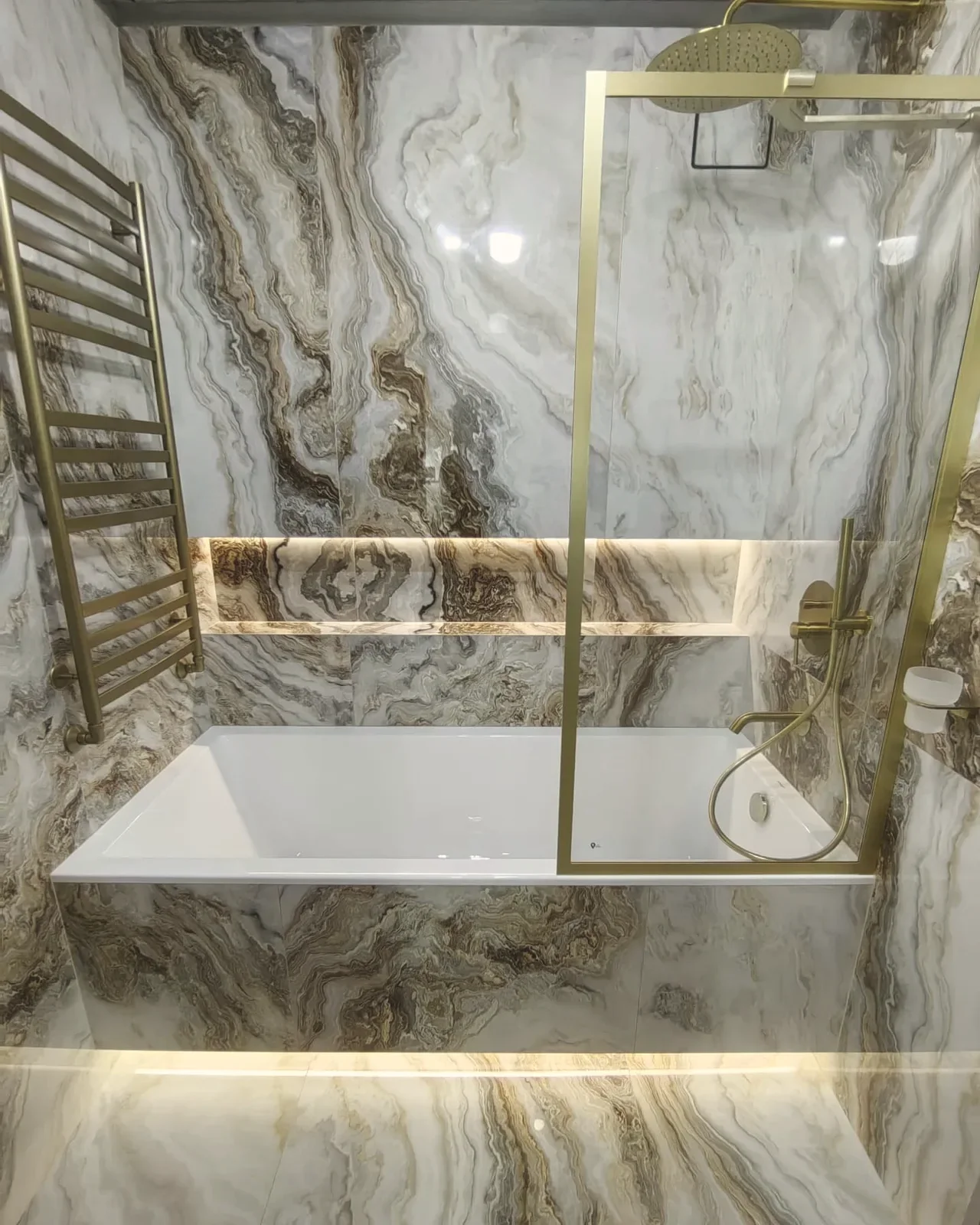
- Chigwell (IG7). A book-matched onyx bathroom with brass fittings, completed in spring 2025 — the mirrored stone veining is the kind of finish that lives in the design-led tier.
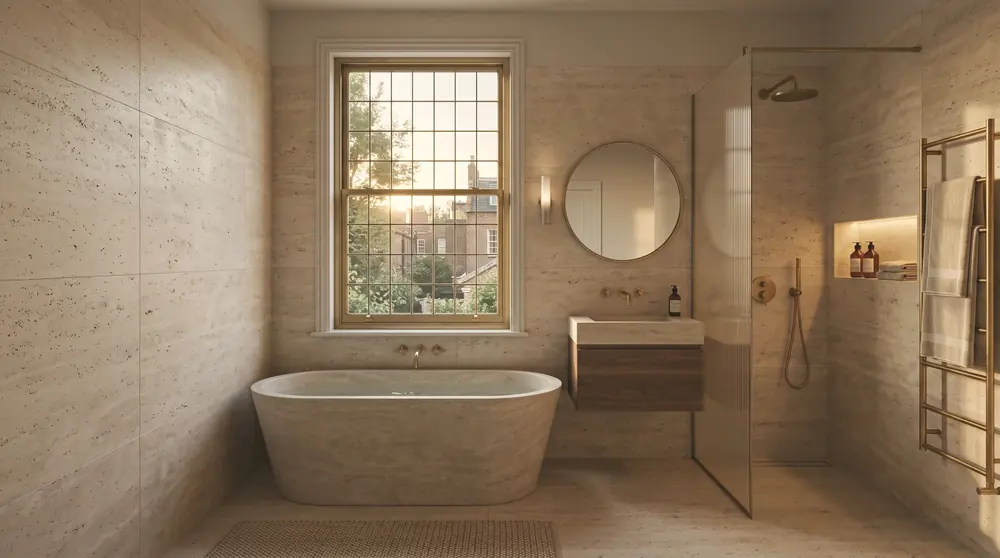
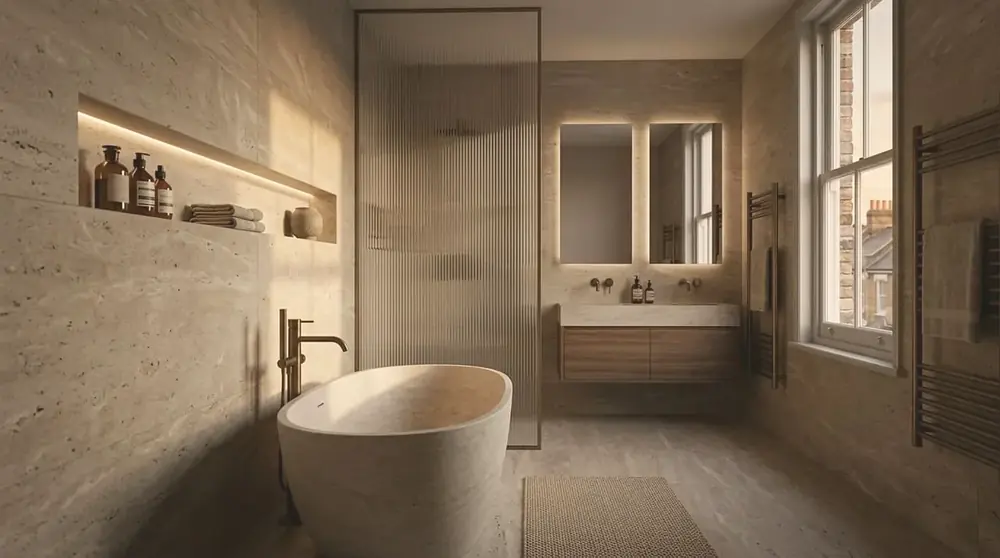
- Buckhurst Hill (IG9). A stone-effect wet room with a tiled trough basin, finished in autumn 2024 — a clean, level-access room in an inter-war semi.
- Woodford Green (IG8). An onyx-effect bathroom with a black rainfall shower, completed in 2026, on one of the deeper plots the Woodford area is known for.
- Ilford (IG1). A stone-grey wet room and shower refit finished in spring 2025, in the Edwardian terrace stock that runs through Ilford.
We take on bathrooms and en suites in Loughton just as regularly. Whether it is a full bathroom renovation in Woodford Green or a compact refit handled by our bathroom fitters in Ilford, the same crew and the same itemised approach carry the job from first day to last. You can see the finished rooms in our project gallery; the photographs are the honest record of the work rather than a showroom set.
Timeline and living without a bathroom
How long you are out of a working bathroom depends on the tier, not the town:
- A same-footprint refresh: roughly seven to ten working days.
- A full strip-out on the same layout: about three to four weeks.
- A reconfigured room or wet room: five to eight weeks, longer where natural stone or made-to-measure joinery carries a lead time.
Two things quietly decide whether a job runs long. Tanking and screed need their full cure before tiling can begin — pushing that is how leaks start — and any specialist stone or tile has to be ordered before the strip-out, not during it. If it is your only bathroom, that gap matters, so where the layout allows we sequence the work to keep a WC usable for as much of the build as possible and give you honest dates up front rather than optimistic ones.
How the agreed price holds
A bathroom budget stays put when two things are settled early. Every choice — the suite, the brassware, the tile, the glass and the heating — is selected and priced before the strip-out begins, because a change of mind mid-build is the most expensive way to renovate. And anything genuinely unforeseen behind the plaster comes to you with a price to approve before the work goes ahead, never as a quiet line on the final invoice.
That is how we run every job: a quote broken down to trade level that you can question row by row, dates fixed in writing, one person carrying the room from the first measure to the last bead of sealant, and the reassurance of £10m Employers' Liability and £5m Public Liability standing behind the work. Any heating or boiler alterations are arranged through a Gas Safe registered partner.
Common questions
How much does a bathroom renovation cost in Chigwell, Loughton and the wider IG postcodes?
In 2026 a like-for-like refresh across the Epping Forest corridor runs about £11,000 to £15,000, a full strip-out on the same layout about £15,000 to £22,000, and a reconfigured room or wet room roughly £22,000 to £33,000. Design-led schemes reach £33,000 to £49,000+. Every figure is confirmed at survey rather than over the phone.
Can you fit a wet room in a 1930s Essex semi?
Usually yes, but the floor decides it. On a suspended timber floor the joists must be checked for movement before the area is tanked, because any flex will crack the waterproof seal. Solid ground floors are more forgiving. We confirm the floor build-up and the fall to the drain at the survey rather than assuming it once the work has started.
What tends to turn up when you strip out an older bathroom in these areas?
In inter-war and period homes the common finds are lead supply pipes on the homeowner's side, tired waste runs, an extractor venting into the loft instead of outside, and joists that need doubling under a heavy bath. Coatings and adhesives from before 2000 can contain asbestos, so a refurbishment survey settles that before anything is broken out.
How long will I be without a bathroom?
A same-footprint refresh is usually seven to ten working days. A full strip-out on the same layout takes about three to four weeks, and a reconfigured room or wet room five to eight weeks, longer where stone or made-to-measure joinery carries a lead time. Where it is your only bathroom we sequence the work to keep a WC usable for as long as the layout allows.
Do you cover Chigwell, Buckhurst Hill and Woodford Green?
Yes. We work right across the Epping Forest and IG-postcode corridor, including Chigwell (IG7), Buckhurst Hill (IG9), Loughton (IG10), Woodford Green (IG8) and Ilford (IG1). Any heating or boiler work is arranged through a Gas Safe registered partner. Call +44 20 4652 0005 or book a survey and you will have an itemised written quote to plan around.
Book a bathroom survey in Essex
No bathroom in Chigwell, Loughton, Buckhurst Hill or anywhere along the IG corridor can be priced accurately until someone has seen the floor, the access and where the soil stack runs — which is why the survey comes first and the fixed, itemised quote follows it. PrimeCraft Surface Solutions measures the room, prices it to trade level, puts the dates in writing and keeps one point of contact on the job from the first visit to the last. To get moving, book a no-cost site visit or run your room through the online estimate tool for a first range to plan around. You can reach the team on +44 20 4652 0005, and every job is run from our registered London office and covered by full insurance.