Renovating period homes in West London's conservation areas (2026 guide)
What it costs, what the rules require, and how flat and house owners across W2–W14 and SW5–SW7 get renovation right in 2026.
Renovating a period property in West London in 2026 typically costs £940 to £2,400 per square metre, depending on the building type and specification — and before a single brick moves, most projects need at least one planning or consent step that has nothing to do with building regulations. That might be a conservation-area application, listed-building consent, a lawful-development certificate, freeholder approval, or a combination of all of them. Getting the consents in the right order, running in parallel where possible, is what separates a West London renovation that finishes on programme from one that stalls in the administration.
This guide covers the territory: the housing stock, the planning controls, the specific rules for leasehold flats and mansion blocks, what the restoration line items actually cost in 2026, and a plain cost table by building type and spec.
West London's period stock — and why the controls are dense here
West London has one of the highest concentrations of conservation-area designation in England. Walk from Paddington through Bayswater (W2) and Notting Hill (W11), down through Kensington into South Kensington (SW7) and Earl's Court (SW5), or west through Brook Green (W6) and Chiswick (W4), and you are rarely out of a designated area for more than a few streets.
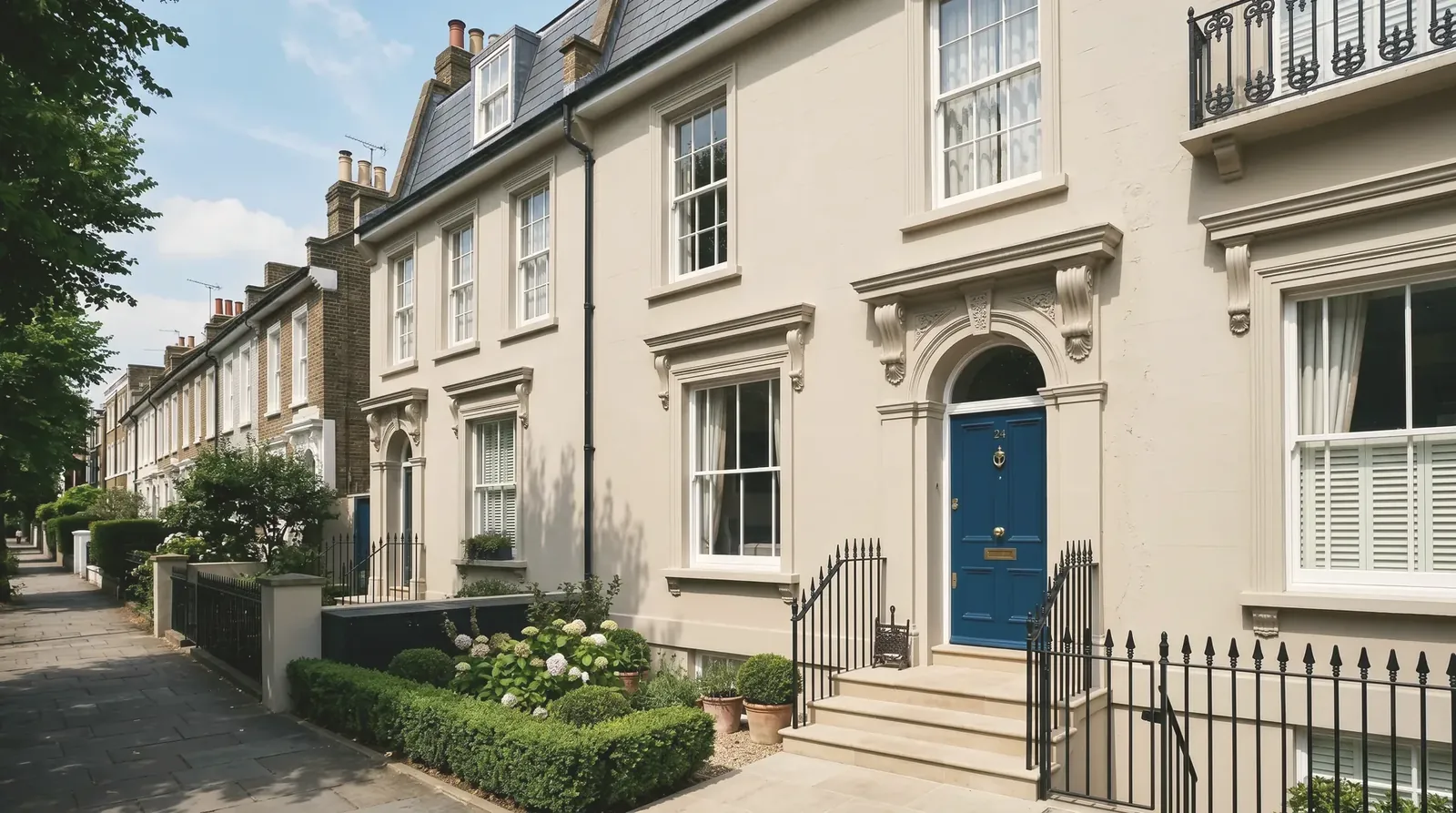
The stock is the reason. These postcodes are dominated by a particular building type: the white-stucco Victorian terrace, put up in the 1840s to 1890s as London expanded west, with shared party walls, deep rear outriggers, tall sash windows, original cornicing, and rendered facades. In Maida Vale (W9) the type is mostly Edwardian mansion blocks — broad-fronted, canal-side, with parquet floors and generous ceiling heights. In Chiswick's Bedford Park (W4), it is Arts-and-Crafts houses from the 1870s and 1880s, with distinctive tile-hung gables and joinery. Around the Edwardes Square area in Kensington (W8) there are listed garden-square terraces.
In SW7 South Kensington, the large houses on Exhibition Road and the surrounding streets are some of the most heavily controlled residential property in London. In W2, the terraces that line Leinster Gardens, Moscow Road and the streets south to Hyde Park are largely conservation-covered. In W11 Notting Hill, entire streets — Lansdowne Road, Elgin Crescent, Colville Terrace — are in conservation areas or are locally listed.
This density of designation is not an obstacle so much as a set of known rules. Once you understand exactly which layer applies to your address, the process is straightforward to programme.
The planning layers — conservation area, Article 4, listed building
Conservation area
A conservation-area designation does not prevent renovation. It does require planning consent for work that permitted development would normally allow without it: removing a chimney stack, replacing roof tiles with a different material, installing external satellite equipment, cladding a wall in a different material, and — critically — any side or rear extension visible from the public highway. For a standard internal refit (new kitchen, bathrooms, replastering, rewiring) inside the original envelope, the conservation designation adds nothing to the process. The rules bite on anything that changes the external appearance.
Where a planning application is needed, the council's design guidance — particularly around windows, doors, render colour, and roof materials — sets the standard. Most London councils in this area (the Royal Borough of Kensington & Chelsea, Hammersmith & Fulham, Westminster, Ealing, and Hounslow for W4) have detailed conservation-area appraisals online. Reading the relevant one before you brief your architect saves a round of redesign.
Article 4 direction
An Article 4 direction removes some or all permitted-development rights from a defined area. Where one applies, the type of work that would otherwise be automatic (an outbuilding, a rear extension within PD limits, a porch, a replacement door) instead needs a full planning application. Bedford Park in W4 is a nationally significant example: its Article 4 direction, applied to protect the original suburban character, means that replacing windows, front doors, or gates, or erecting garden structures, all require consent. There are Article 4 directions on a number of streets in W2, W9, and W11 as well. You check your address on the council's planning portal, or the survey team confirms it at survey stage as part of the pre-design checks.
Listed buildings
A listed building — Grade I, Grade II*, or Grade II — needs listed-building consent for any alteration that affects its character as a building of special interest. This covers far more than people expect: replacing original windows with double-glazed units (the heritage test is the appearance and construction, not just whether it looks similar), removing internal partition walls, altering original fireplaces, or changing the staircase balusters. The consent is separate from planning permission and has no application fee. It is a criminal offence to carry out works requiring it without it.
There are listed buildings throughout W2, W8, W11, SW7 and SW5 — including entire terrace fronts in Bayswater, houses on the Phillimore Estate in W8, and properties flanking the communal gardens in W11. If your property is listed, the first call is to establish exactly what grade and what curtilage, and to get a heritage consultant's brief agreed before drawing anything. Our listed-building renovation guide sets out the consent pathway in detail.
Lawful development certificate
Where a project falls within permitted development, a lawful development certificate (LDC) provides written confirmation from the council. The fee is £103. It is not mandatory, but it speeds up the sale of the property and removes any ambiguity. On a West London renovation where the envelope work is straightforward PD, applying is worth doing; where the work touches the conservation-area controls, the LDC is irrelevant and a planning application is the right route.
Renovating a leasehold flat in West London — lease consent, freeholder, and party wall
A substantial portion of West London housing is leasehold. The white stucco terraces in Bayswater, Notting Hill, and South Kensington were subdivided into flats across the twentieth century; the mansion blocks of Maida Vale and Earl's Court were purpose-built as flats. In both cases, the renovation mechanics are different from a freehold house, and the additional consent requirements are real, not optional.
Freeholder (landlord) consent
Before structural work, a kitchen or bathroom refit, new flooring (in a block with noise covenants), or any change to plumbing or drainage, most residential leases in London require the freeholder's written consent. The standard mechanism is a Licence to Alter — a legal document that sets out what work is approved, the specification standards, the contractor requirements, and who bears the cost of any damage to common parts. The freeholder's solicitors review and issue it; their legal and surveying fees are typically payable by the leaseholder. A Licence to Alter process generally runs £1,200–£3,500, more if the work is extensive.
Some freeholders in this area are large estate companies (the Church Commissioners manage substantial parts of W2, the Portobello Estate extends into W11, Cadogan in SW3/SW7). They have their own standard forms and surveying teams. Getting the specification in front of the right person early — before you spend money on detailed drawings — is the practical advice.
Party wall in mansion blocks
Mansion-block renovations regularly trigger the Party Wall etc. Act 1996. Work to the floor structure (joists, beams, bearing walls) adjacent to a neighbour's flat, new drainage runs inside a shared shaft, or any underpinning in a basement conversion all require formal notice. In a mansion block with multiple adjoining properties across three dimensions — the flat above, the flat below, and the flats to either side — the party-wall process can involve several neighbours simultaneously. Each one has the right to appoint their own surveyor; you cover both bills. Allow 14 days from notice for agreement without dissent; a contested award adds further weeks. The full party-wall mechanics are set out in our party-wall guide.
The practical sequence for a mansion-block renovation: confirm the lease terms and freeholder contact on day one; commission any structural investigation; begin the Licence to Alter alongside the design; serve party-wall notices the day the scheme is locked and agreed with the freeholder, not the week the build starts. Running these tracks in parallel, rather than sequentially, is how the programme stays on time.
The restoration line items — what period features cost to repair in 2026
West London period properties are worth renovating properly — the fabric is why the postcode commands the price it does. Stripping out cornices and running smooth plasterboard ceilings loses something permanent and, at the price these properties trade at, is a bad trade. Here are the main restoration items and their 2026 cost ranges; deeper period repair of this kind sits alongside the wider renovation programme.
Sash windows
The timber double-hung sash window is the defining external feature of a West London stucco terrace. Replacing originals with modern aluminium or uPVC is almost always refused in a conservation area; the normal route is overhaul and draught-sealing, with secondary glazing added behind. Overhauling an existing sash window — restoring the weights and cords, planing and sealing the frames, fitting brush-pile draught seals and servicing the pulleys — typically runs £850–£1,800 per window in 2026, depending on size and condition. Putting in slimline secondary glazing behind, which brings the acoustic and thermal performance close to modern double-glazing, adds £300–£700 per unit.
If the originals are beyond repair — rotted sills, sprung joints, lost glazing bars — a purpose-made timber sash to match the original profile can be made and installed for £1,600–£3,200 per window, subject to the council's consent requirements. This kind of bespoke joinery is matched to the original profile rather than supplied off the shelf.
Cornicing and plasterwork
Original run-in-place cornices in West London Victorian rooms are a significant asset. Repairing cracked or detached sections — cutting back, re-keying the lath or substrate, refilling with a lime-plaster mix and rerunning the profile — typically costs £90–£200 per metre in 2026, depending on complexity. Reinstating a whole length from a surviving section or a profile run on site is at the upper end. Matching patched sections without a visible seam takes experience; a lime-based mix moves with the building rather than a rigid modern plaster that cracks at the join.
Walls and ceilings in Victorian properties that have never been skimmed in gypsum are frequently solid lime plaster on metal lath or timber. Re-keying and repairing a lime-plaster wall surface that has softened or detached costs £60–£130 per m². Full take-off and re-plastering in a traditional lime system is £95–£165 per m². The case for keeping original lime plaster where possible is practical as well as aesthetic: it breathes, it handles movement better than hard plaster, and it is what the walls were built to accommodate.
External stucco
The white-painted stucco render on a Bayswater, Notting Hill, or South Kensington terrace is functional as well as decorative — it is a waterproof skin over the London Stock brick behind. Areas that have cracked, delaminated, or been patched in a hard cement render need careful attention: hard cement applied over the original lime-based stucco traps moisture behind it, accelerates decay, and creates a different expansion response that causes further cracking. Re-rendering in a matching lime-based or heritage stucco system and repainting typically costs £75–£155 per m² of elevation in 2026, depending on the extent of preparation and the number of coats. The final coats are part of the wider exterior painting and decoration package.
Work to the front elevation of a conservation-area property — including rerendering, repainting to a different colour, or replacing sections of moulding — may require planning consent. The threshold is confirmed at survey.
Cost table — period renovation in West London, 2026
| Building type | Spec | Typical £/m² | Notes | |---|---|---|---| | Mansion-block flat (leasehold) | Mid-spec refit: services, kitchen, bathrooms, decoration | £940–£1,450/m² | Excludes Licence to Alter fees and party-wall costs | | Mansion-block flat (leasehold) | High-spec: + period features restored, premium finishes | £1,500–£2,100/m² | Cornicing, sashes, original flooring retained and restored | | Stucco terrace / townhouse | Mid-spec renovation: structure, services, rooms replanned | £1,050–£1,600/m² | Excludes extension footprint; may include rear infill | | Stucco terrace / townhouse | High-spec: + full restoration, bespoke joinery, premium fit-out | £1,650–£2,400/m² | Sashes, cornicing, stucco, specialist sub-contractors | | Listed-building element | Any spec | Add 15–25% to the above | Heritage consultant fees, additional consents, approved materials | | Sash window overhaul | Per window | £850–£1,800 | Includes draught-sealing and cord replacement | | Cornicing repair | Per metre run | £90–£200 | Depends on profile and substrate condition | | Lime plaster repair | Per m² | £60–£130 | Re-key and repair to existing lime-plaster surface | | External stucco patch/rerender | Per m² of elevation | £75–£155 | Heritage lime/stucco system |
These are 2026 market ranges for guidance, not a quote. Statutory costs are real: listed-building consent has no application fee; a lawful development certificate is £103. Licence to Alter (leasehold) legal and surveying fees are additional, typically £1,200–£3,500. Party-wall surveyor fees per adjoining owner are typically £700–£1,500.
FAQ
How much does it cost to renovate a period flat in West London in 2026?
For a mansion-block or converted-terrace flat in W2, W9, W11, SW5 or SW7, a full mid-spec refit — rewiring, replumbing, replastered walls and ceilings, a new kitchen and bathrooms, and full redecoration — typically runs £940–£1,450 per square metre in 2026. A 65 m² flat comes in at roughly £61,000–£94,000 at that spec. High-spec, with period features restored and premium finishes throughout, is £1,500–£2,100/m². These figures exclude the Licence to Alter fees and any party-wall costs, which are additional.
Do I need planning permission to renovate inside a West London flat?
For a standard internal refit — new kitchen, bathroom, replastering, rewiring — inside the flat's existing footprint, no planning permission is required. Work that affects the external appearance of the building (new windows, any change to the roof or facade), that touches a load-bearing structure shared with the building, or that occurs in a listed building all bring additional requirements. The Licence to Alter from the freeholder is a separate consent and is almost always required for structural or services work; it is not a planning permission.
What does Article 4 mean for my renovation in West London?
An Article 4 direction removes some or all permitted-development rights. Work that would normally proceed without a planning application — a rear extension within PD limits, a replacement door, new windows — instead needs full consent. Bedford Park (W4) is the most extensive example in West London, but Article 4 directions apply to specific streets in W2, W9, W11 and elsewhere. You check your address on the relevant council's planning portal; it is worth verifying at the survey as a standard first step.
Can I replace the sash windows in a conservation area?
Replacing original timber sash windows with uPVC or aluminium is almost always refused in a West London conservation area. The normal approved route is overhauling the originals — restoring the mechanism, sealing the frame, fitting brush-pile draught seals — sometimes with slimline secondary glazing fitted behind. Where a window is genuinely beyond repair, a purpose-made timber sash to the original profile can be approved; the council's consent is required before installation. Cost in 2026: £850–£1,800 per window for overhaul; £1,600–£3,200 for a purpose-made replacement.
Does a leasehold flat renovation need consent from the freeholder?
Yes, in almost every case where the work is structural, involves services, affects flooring, or changes the layout. The mechanism is a Licence to Alter — a legal document from the freeholder's solicitors that sets out what is approved and to what standard. The leaseholder pays the freeholder's costs. The process generally costs £1,200–£3,500 for straightforward applications; more for complex structural schemes. Starting the Licence to Alter process early — before detailed drawings are completed — is the practical way to avoid delays.
How long does a period flat renovation in West London take?
A full refit of a 60–80 m² mansion-block flat with no structural changes: 14–20 weeks from survey to handover. Add four to six weeks if a Licence to Alter is involved and progressed in parallel; add a further four to eight weeks if party-wall notices are contested. Structural work — opening walls, reconfiguring a layout with new steel — adds on-site time depending on complexity. The programme is agreed in writing before work starts.
What is the difference between a listed building and a conservation area?
A conservation area is a designated district — a street, a neighbourhood, a set of buildings — where the collective character is protected. It controls external changes and some demolition but does not require consent for internal work on unlisted buildings. A listed building is a specific property, protected individually for its historic or architectural significance. Any alteration to a listed building — internal or external — that affects its special interest requires listed-building consent, regardless of whether it is in a conservation area. Many West London properties are both. For a wider house-type walkthrough, see our Victorian house renovation guide and the full-house renovation cost guide for 2026.
Closing CTA
The planning and consent picture in West London is something to work through on every job before drawing anything: check the conservation-area designation, the Article 4 status, and the listed-building register at the survey visit, confirm the leasehold position, and establish what consents are needed and in what order. A good quote separates the structure, the services, the fit-out, and the restoration work as individual lines, with the Licence to Alter and party-wall steps shown alongside the build programme.
PrimeCraft Surface Solutions (company no. 16070669) works across West London — Bayswater W2, Maida Vale W9, Notting Hill W11, Chiswick W4, Hammersmith and Brook Green W6, Shepherd's Bush W12, Earl's Court SW5, and South Kensington SW7 — and across Greater London and the home counties beyond. Arrange a free site visit through our online estimate page, or use the estimator for a first range.