Victorian terrace extensions in South-West London (2026): side-returns, rear extensions and loft conversions
Extending a Victorian or Edwardian terrace in SW London: cost ranges, the clay and planning realities, and how the three projects compare.
Extending a Victorian or Edwardian terrace in South-West London in 2026 typically costs £52,000 to £92,000 for a single-storey rear or side-return extension, and £52,000 to £88,000 for a terraced dormer loft — all-in figures including structure, glazing and fit-out. The "between the commons" belt — Clapham (SW4), Battersea (SW11), Stockwell (SW9), Tooting (SW17), Earlsfield (SW18), and the streets running out to Balham, Putney (SW15) and Wimbledon (SW19) — is some of the densest Victorian terrace stock in London. Most of these houses were never finished: the rear outrigger almost always left a side alley, the roof sits under the 40 m³ permitted-development limit, and the ground floors are dark because the back wall was never meant to open. Three projects change all of that. This guide tells you what each one costs in this specific part of London, what makes them harder here than on a wider plot, and how to sequence them if you want more than one.
Why South-West London terraces suit extension so well
The band of streets between Clapham Common and Wandsworth Common — running through SW4, SW11 and into SW18 — is built almost entirely on the same template: two storeys, brick-stock façade, a rear outrigger that stops a metre or two short of the back fence, and a service alley running beside it. South and east of there, the same housing stock extends through Stockwell (SW9), South Lambeth (SW8), Tooting Bec (SW17), and the Victorian streets around Tooting Broadway and Earlsfield station. Putney (SW15), Wimbledon (SW19) and Wandsworth Town also carry large pockets of the same type, particularly the detached and semi-detached Edwardian houses that generate a higher PD volume allowance (50 m³ against the terrace's 40 m³).
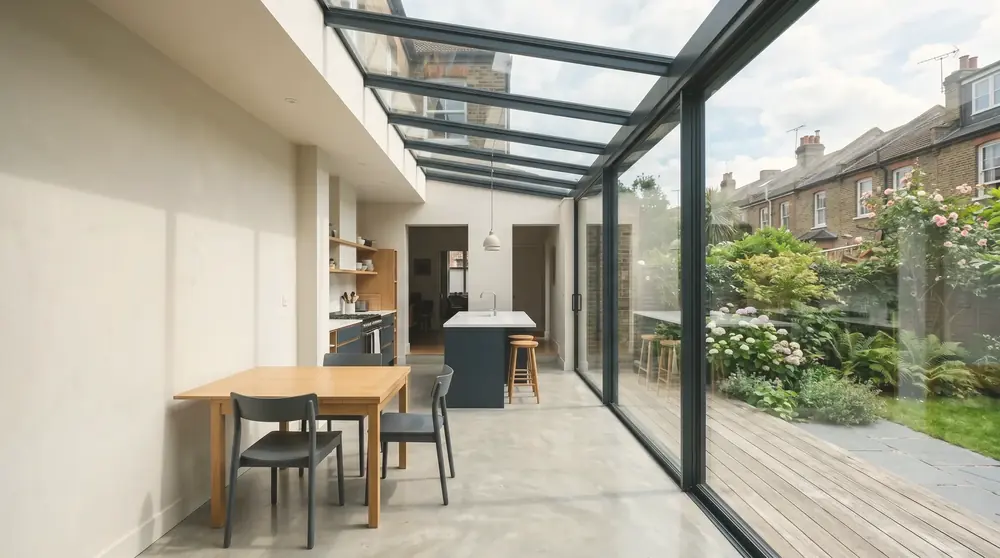
What makes this stock so suited to extension is structural rather than aesthetic. The outrigger layout hands you a defined side passage — narrow but there — and a rear elevation that was never load-bearing across its full width. The houses are usually 4.5 to 5.5 metres wide at the back wall, leaving room for a 2 m or wider infill down the side without touching the neighbours' eaves line. The roof pitch is shallow enough that a dormer at the back sits comfortably inside PD volume limits. And the ground floors are genuinely dark: an original Victorian terrace kitchen looks south, but the side and rear walls block the light. A glazed roof lantern or full-width bifolds onto the garden changes the room more than any other single change to the house.
That combination — an obvious structural opportunity, a coherent housing type, and a planning framework that often accommodates the work without a full application — is why side-returns, rear extensions and loft conversions are the three jobs that dominate the quotebooks of every builder working this stretch of south-west London.
The three projects compared: which one makes sense first?
There is no universal answer, but there is a decision logic.
Side-return extension makes sense when the outrigger is present and the ground floor is the priority. You gain 7–12 m² of floor area, but the spatial change is bigger: the kitchen goes from a 2.8 m-wide galley to a 4.5–5 m-wide room. The side return also forces the kitchen to be redone, which is both a cost and an opportunity — you are fitting out the enlarged room from scratch rather than reinstating a kitchen in the same space. If the kitchen is the main driver, this is nearly always the better choice over a simple rear extension because you gain width as well as depth. Our side-return extension guide sets out the value case in full.
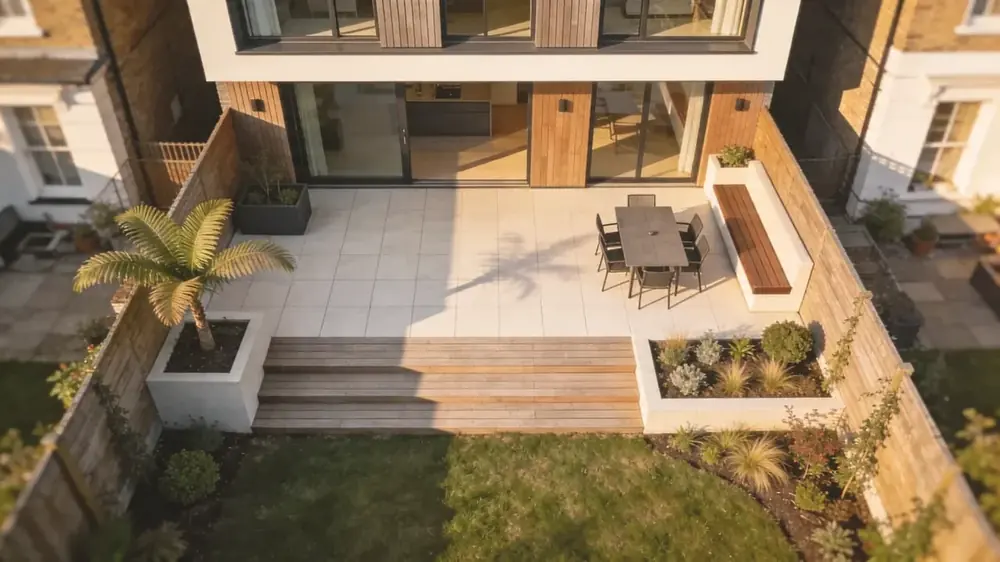
Rear extension makes sense where there is no usable side return, where the plot runs wide enough that a deeper footprint is the priority, or where you want the additional floor area without redoing the entire kitchen. Single-storey rear extensions on SW London terraces typically extend 3–6 m under the permitted-development rear-depth rules (3 m for a terrace under standard PD; up to 6 m with prior approval under the neighbour-consultation scheme). A two-storey rear extension requires a planning application.
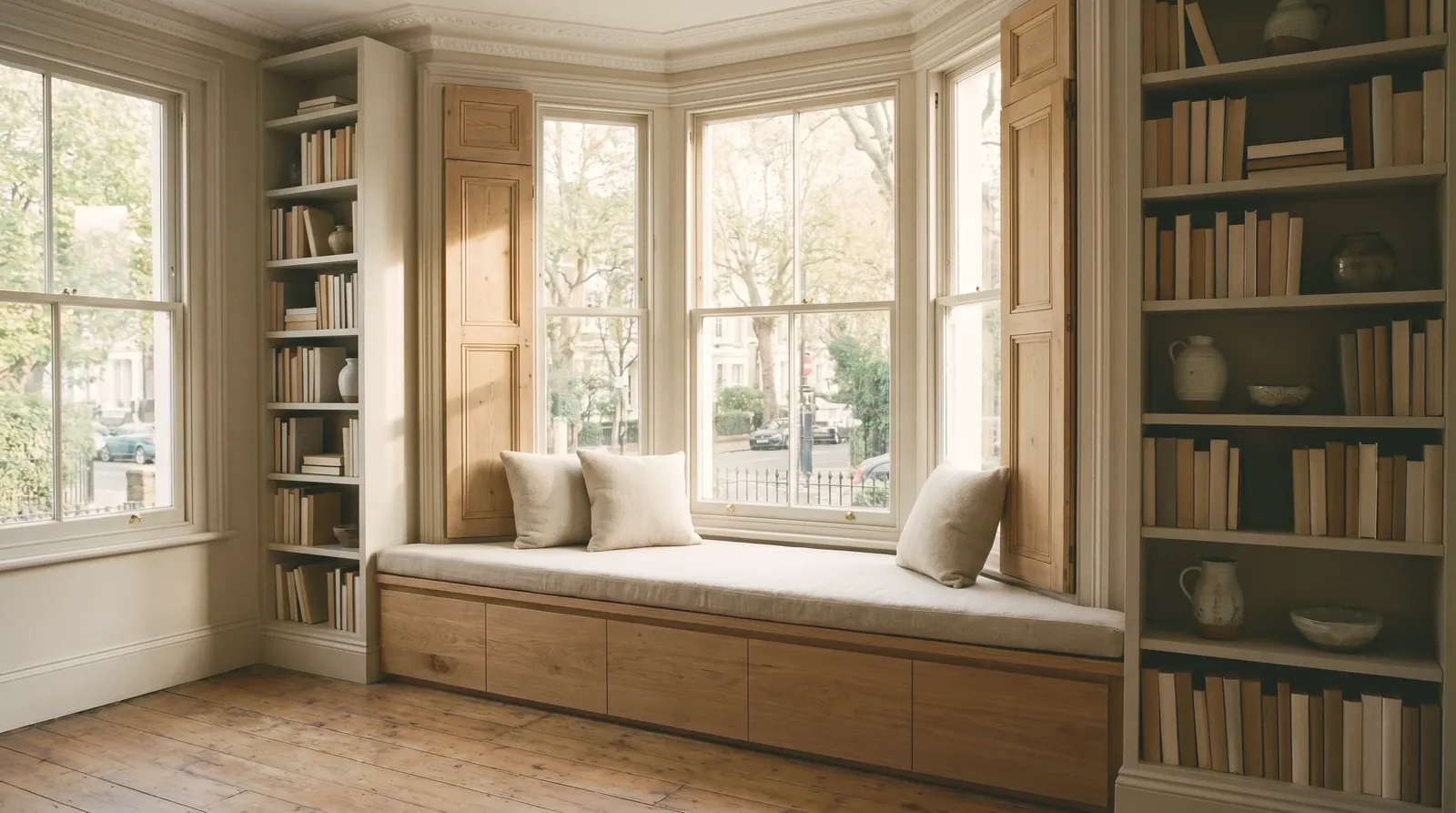
Loft conversion makes sense when bedroom count is the limiting factor rather than ground-floor space. On a standard SW London two-storey terrace, a dormer at the rear stays within the 40 m³ PD volume limit and adds one bedroom with an en-suite, sometimes two rooms. It does not touch the ground floor at all — it is a separate programme with its own disruption profile. Where both the loft and the ground floor need doing, the sequencing question matters: see below.
What it costs: a region-specific comparison table
These are 2026 all-in ranges for mid-spec projects across the SW London terrace belt. "All-in" means structure, roof, glazing and basic fit-out (no kitchen allowance in the rear extension and loft figures; kitchen budget is shown as its own line in the side-return).
| Project | Typical SW London range (2026) | What it adds | |---|---|---| | Side-return infill (7–12 m²), no kitchen | £40,000–£65,000 | Ground-floor width + daylight | | Side-return infill + new kitchen, mid-spec | £58,000–£92,000 | Transformed ground floor | | Single-storey rear extension (15–20 m²) | £52,000–£90,000 | Living/dining floor area | | Terraced dormer loft conversion | £52,000–£88,000 | One bedroom + en-suite | | Combined side-return + dormer loft | £105,000–£165,000 | Two major interventions, one programme | | Two-storey rear extension (planning req'd) | £85,000–£145,000 | Two floors added at rear |
Prices vary across the postcode band. Work in Clapham (SW4) and Battersea (SW11) sits toward the upper end of these ranges, reflecting higher labour and site costs in inner south London. Earlsfield (SW18), Tooting (SW17) and Wimbledon (SW19) generally run slightly lower for the same spec. Party-wall costs are additional and depend on how many neighbours are affected (see below).
Planning and conservation in Wandsworth and Lambeth
Most single extensions on a standard SW London terrace are permitted development. The key numbers:
- Rear extension (single-storey, terrace): up to 3 m deep under standard PD; up to 6 m under the neighbour-consultation scheme (prior-approval application, not full planning).
- Loft conversion (terrace): up to 40 m³ added volume within PD; 50 m³ for semi-detached or detached.
- Lawful development certificate: £103 to apply; worth every penny on a terrace where resale due diligence is thorough.
The two things that switch off permitted development most often in this part of London are conservation-area designation and Article 4 directions.
Wandsworth (covering SW4 in part, SW11, SW12, SW17, SW18, SW19) has a large number of conservation areas — Northcote Road, the Battersea Rise streets, areas around Wandsworth Town, parts of Wimbledon Village, the Nightingale conservation area in Balham. Lambeth (covering SW4, SW8, SW9) has its own designations including the Stockwell Park conservation area and parts of Clapham Old Town. In a conservation area, a side extension visible from a road or a rear extension over 1 m from the rear wall of the original house needs an application. Materials and roof form attract scrutiny.
Article 4 directions — which local authorities can use to withdraw specific PD rights from defined streets — are less common across this part of London than in some central London boroughs, but they exist. We check the planning record for your specific address before any design fees are spent.
Where a planning application is needed, Wandsworth has historically taken eight to twelve weeks to determine straightforward householder applications; Lambeth is similar. Conservation-area applications go through the same route but with slightly more thorough scrutiny of external materials and form. Historic England guidance (for listed buildings, of which there are a handful in the older conservation areas around Clapham and Battersea) adds a further layer.
The party-wall reality on a tight terrace
The Victorian terraces between the commons are among the densest in London. Side passages can be less than a metre wide, and shared walls run the full depth of the house. Both facts make the Party Wall etc. Act 1996 nearly unavoidable:
- A side-return infill almost always requires a party-wall notice to the neighbour on the shared side, because new foundations go into the boundary and the work usually affects the shared wall itself.
- A rear extension that excavates below the level of the neighbouring foundations (common with London-clay footings) requires notice even where the rear garden is not shared.
- A loft conversion that cuts into or alters the shared wall — which most dormer conversions do — also requires notice.
Notice must be served before work starts. The neighbour then has 14 days to consent or to dissent. Where they dissent and appoint their own surveyor, you cover both bills — set aside £700–£1,500 per adjoining owner. The practical rule is to serve notice the day the structural drawings are finalised, not the week before work is due to start: a contested award typically takes four to six weeks to agree, and a dispute can extend that further. On a scheme with two adjoining neighbours, allow for both. The full mechanics are covered in our party-wall guide.
SW London clay: what it does to your foundations
London clay runs under virtually all of the terrace belt described here — from Stockwell and Clapham through Balham, Tooting, Wandsworth and Earlsfield, and under most of Putney and Wimbledon. London clay is shrink-swell clay: it contracts in dry summers (particularly where mature trees are drawing moisture) and swells in wet winters. Victorian foundations, built on shallow strip footings at 600–900 mm depth, were set when the mature tree cover was much lighter. A new extension cannot use the same footings.
Current practice for extensions over London clay is to take new foundations to a minimum of 1.2–1.5 m; where there are mature trees (plane, oak, ash — common along the streets between the commons), engineers may specify 2 m or deeper, confirmed by a soil investigation. That adds cost and time to the groundworks line: allow £8,000–£14,000 for strip or pad foundations on a standard side-return or rear extension on this ground.
In practical terms, the clay affects the sequence of the job: groundworks are the first thing on site and the point at which unforeseen variation most commonly arises. A fixed-price quote is therefore more important here than on a site where the ground is known and predictable.
Sequencing a combined programme: side-return + loft together
If the ground floor and the loft both need doing, running them together is nearly always the more economical route. The main saving is on preliminaries: a site hoarding is up once, scaffold is up once, the dust and disruption is consolidated into a single period rather than two. The typical saving on a combined programme versus two separate jobs run twelve months apart is £6,000–£14,000 on shared preliminaries and scaffold alone.
The key sequencing logic:
- Structural calculations for both works are done together — the engineer models the loft loads on the roof before any rear beam sizing is finalised, so the structure works as a whole.
- The rear steel (RSJ or rolled-steel channel, £5,500–£11,000 supplied and fitted) is ordered as soon as the design is locked, because fabrication takes three to five weeks and the build cannot reach that stage without it.
- The loft dormer is usually built before the side-return roof is opened up — working top-down keeps the interior weather-tight for longer.
- First-fix electrics and plumbing for both floors are done in one visit, not two.
- The kitchen order is placed at the same time as the structural drawings are signed off. Bespoke and semi-bespoke kitchens carry an eight to fourteen-week lead time from order to delivery.
One project manager covers the whole programme. You get one point of contact, one programme, one set of party-wall notices.
Full all-in cost: what the worksheet includes
Most quotes for extensions show the build cost. The figure you actually need to hold in your head includes everything that a poorly specified quote omits. Here is the full picture for a combined side-return + dormer loft on a standard SW London two-storey terrace, 2026 mid-spec:
| Element | 2026 cost range | |---|---| | Structural engineer (both works) | £2,000–£4,000 | | Architect/designer drawings (both works) | £4,000–£9,000 | | Lawful development certificate (per application) | £103 each | | Party-wall surveyor (per adjoining owner) | £700–£1,500 | | Groundworks and foundations (London clay) | £8,000–£14,000 | | Side-return: walls, flat/lantern roof, glazed doors | £22,000–£38,000 | | Rear dormer structure, timber, slate/EPDM | £18,000–£28,000 | | Steel beam and RSJ fitting (rear opening) | £5,500–£11,000 | | First-fix electrics + plumbing (both floors) | £7,000–£13,000 | | Plaster, screed, decoration (both floors) | £7,000–£12,000 | | New kitchen, mid-spec | £18,000–£28,000 | | Loft bathroom + en-suite | £9,000–£17,000 | | Combined programme total | £105,000–£165,000 |
Running the side-return alone without the loft: £58,000–£92,000 including a mid-spec kitchen. The loft alone: £52,000–£88,000 depending on dormer width and the level of the en-suite.
Frequently asked questions
How much does a side-return extension cost in South-West London in 2026? A side-return infill on a standard SW London Victorian terrace — structure, roof, glazing and a mid-spec kitchen — runs between £58,000 and £92,000 all-in for 2026. Strip out the kitchen and the build-only figure sits at £40,000–£65,000. The variables are the steel span required to carry the flank-wall load, whether the roof carries a glazed lantern or a solid section, and what the drainage diversion involves. Work in Clapham (SW4) and Battersea (SW11) typically runs toward the higher end; Tooting (SW17) and Earlsfield (SW18) slightly lower.
Do I need planning permission for a rear extension on my Victorian terrace in SW London? Usually not for a ground-floor single-storey extension. Under permitted development, a rear extension on a terrace can go up to 3 m from the original rear wall without a full planning application (up to 6 m under the neighbour-consultation/prior-approval route). Conservation-area designation — which applies to many streets in SW4, SW11, SW9 and parts of SW18 — changes that: an extension at the rear that was originally more than 1 m from the rear wall needs an application, and materials must match. A lawful development certificate costs £103 and confirms your PD status in writing for resale purposes. We check your address against the planning map before any design spend.
Does a loft conversion on a terraced house need planning permission in SW London? Most terraced dormer loft conversions in SW17, SW18, SW4 and the wider belt sit within the 40 m³ permitted-development volume limit and need no planning application. The exceptions are conservation-area streets — where a dormer visible from the road is not PD — listed buildings, and any house that has already used part of its 40 m³ volume allowance with a previous loft conversion or roof alteration. Semi-detached and detached Edwardian houses (more common in Putney SW15, Wimbledon SW19 and the Wandsworth end of SW18) have a 50 m³ allowance.
Why does party wall come up on almost every extension in this area? Because the houses are tightly packed on a Victorian plot. Side-return infills go right to the boundary. Rear extensions with London-clay footings excavate at the level of, or below, the adjacent foundations. Dormer loft conversions alter the shared roof structure. Any of these triggers the Party Wall etc. Act 1996, requiring notice to be served on adjoining owners. The 14-day notice period is a minimum; a contested award adds four to six weeks. Allow £700–£1,500 per adjoining owner for their surveyor's fees. See our party-wall guide for the full sequence.
How deep do foundations need to be for an extension on London clay? A minimum of 1.2–1.5 m for most of the SW London terrace belt. Where mature trees are nearby — the plane and ash trees that line the streets around Clapham Common (SW4), Wandsworth Common (SW18) or Tooting Bec Common (SW17) — a structural engineer may specify 2 m or deeper, confirmed by a soil investigation. The shrink-swell behaviour of London clay means the Victorian original footings at 600–900 mm are too shallow for a new extension; the new foundations must go to a stable, consistent moisture horizon.
Can I combine a side-return and a loft in one programme? Yes, and it is usually the more efficient route than running them separately. One set of structural drawings, one scaffold erection, one programme of party-wall notices, and preliminary costs shared across both works rather than duplicated. The saving on shared prelims and scaffold alone typically runs £6,000–£14,000 compared with two separate programmes twelve months apart. The critical co-ordination point is the kitchen — order it at the same time the structural drawings are signed off, because lead times of eight to fourteen weeks mean it must be placed early.
What postcode areas does PrimeCraft Surface Solutions cover in SW London? We work across the full SW London terrace belt: Clapham (SW4), Battersea (SW11), Stockwell (SW9), South Lambeth and Nine Elms (SW8), Balham (SW12), Putney (SW15), Tooting (SW17), Earlsfield and Wandsworth (SW18), and Wimbledon (SW19). Work extends across Greater London and into the home counties beyond. See the area pages for Clapham, Battersea, Tooting, Earlsfield and Stockwell for more detail on local planning designations and typical costs by postcode.
Get a clear figure for your SW London project
A side-return, rear extension or loft conversion in South-West London cannot be priced from a photo. The steel span, the ground depth, the glazing spec, the drainage route and the party-wall position all move the number — which is why quotes that skip those details are the ones that come apart on site.
PrimeCraft Surface Solutions (company no. 16070669) surveys the rear and the loft, brings in a structural engineer for the opening sizes and the foundation depths, and returns with an itemised written quote that breaks structure, roof, glazing, drainage and fit-out into separate lines. Dates are set in writing before work begins. One project manager runs the whole renovation from the first visit to the final handover. We work across SW4, SW8, SW9, SW11, SW12, SW15, SW17, SW18, SW19 and the wider Greater London area.
Request a free site visit or get a first range from the online estimator. See also our full guide to what a house extension costs in London in 2026. If you are weighing up an open-plan kitchen extension, that comparison guide is worth reading before the survey.