House extension cost in London (2026): a plot-by-plot guide
Work out which extension your London plot allows, then the all-in 2026 price for rear, side-return, two-storey and wrap-around builds.
The cost of extending a London house in 2026 comes down to one question before any other: what will your plot let you build? Once that's settled, expect to pay roughly £2,000 to £4,150 per square metre for the structure and finishes, plus a fixed list of fees that most first quotes leave off. For a 25 m² single-storey rear addition that usually means £55,000 to £95,000 by the time it's a finished, usable room. This guide works it out in three steps — what your plot allows, the all-in number, and the checklist that gets you an accurate quote.
Step 1 — What your plot allows
Start here, because the shape of your plot decides both the design and most of the cost. Five configurations cover almost every London house:
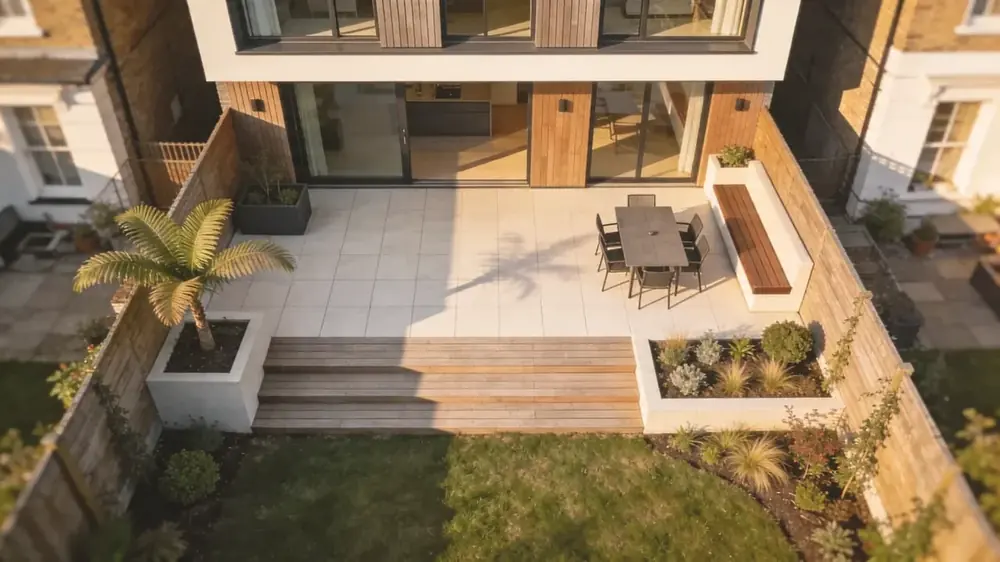
- A single-storey rear extension pushes straight out into the garden. It is the simplest to build and the easiest to scaffold and weatherproof, which keeps the rate down. Reckon on £2,000–£3,500 per m².
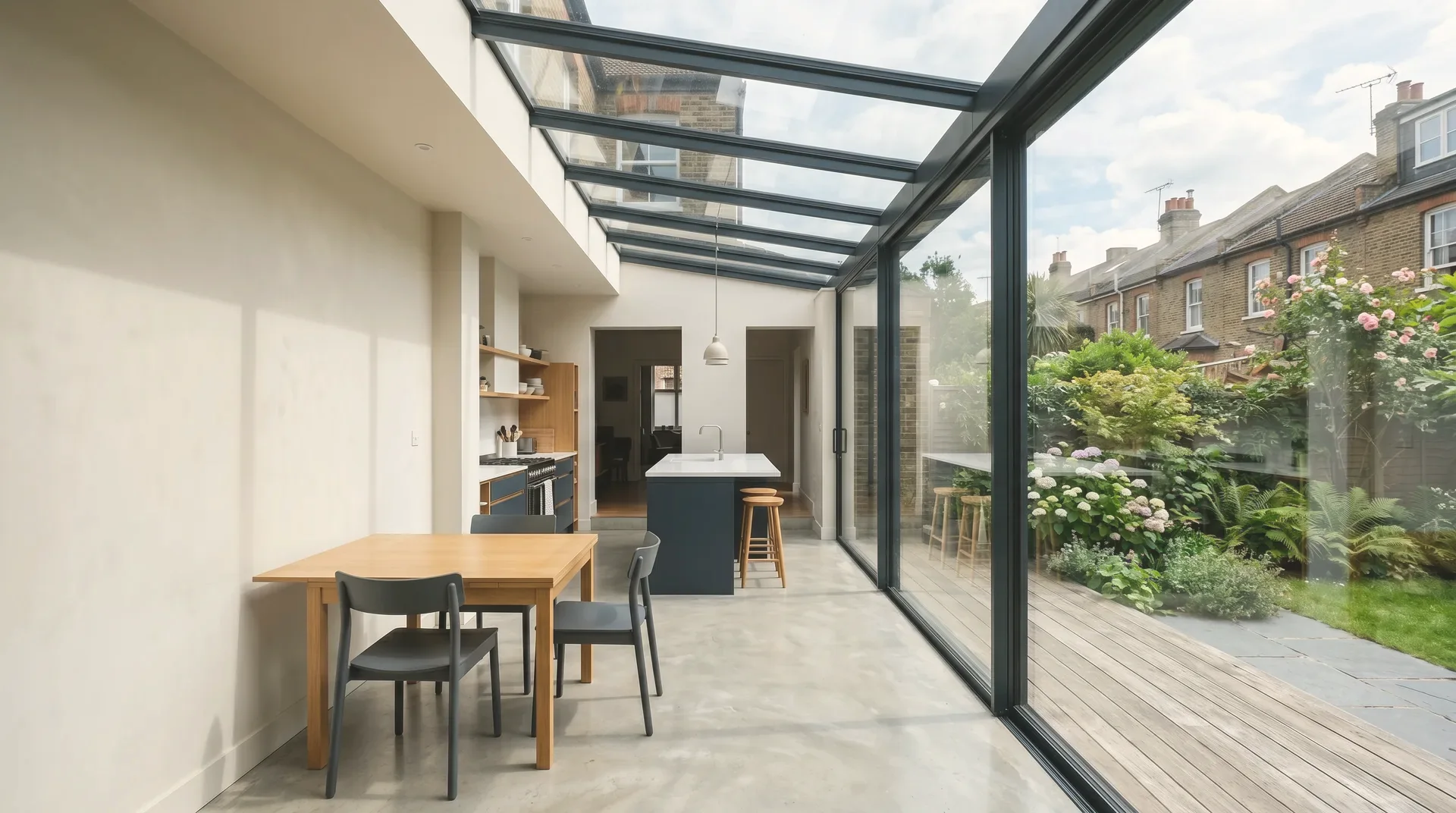
- A side-return infill fills the narrow alley beside a terrace's back addition — usually 1.8 to 2.5 metres of dead space — and turns the cramped rear into one wide room. Tighter to work in, more steelwork, so £2,200–£3,700 per m².
- A wrap-around does both at once: rear plus side-return in a single build. The most transformative ground-floor change, and efficient per m² because the groundworks and overheads are shared. £2,300–£3,800 per m².
- A two-storey rear extension stacks a room above the ground-floor one. The per-m² rate climbs because you are now carrying a new floor on structural walls, but the cost per room you gain is often the best of the lot. £2,400–£4,150 per m².
- An over-garage extension borrows the existing garage slab and walls, so the rate is the lowest here at £1,800–£3,050 per m² — provided the garage structure is sound, which on many 1970s garages it isn't.
All figures are London 2026, materials and labour, and we'd confirm yours at the survey.
Step 1b — The planning gate (check before you spend on drawings)
A lot of single-storey rear extensions on houses are permitted development, meaning no full planning application. A terraced house can go up to 6 metres off the original rear wall (you need a prior-approval application above 4 metres), a detached house up to 8 metres, with a 4-metre height cap and no more than half the garden built over. Flats and maisonettes get none of this — permitted development simply doesn't apply to them.
Three things switch the rules off, and all three are common in London:
- A conservation area, which covers a large share of the inner boroughs.
- An Article 4 direction, where a borough has stripped permitted-development rights from a street or the whole area.
- A listed building, which always needs listed building consent on top.
If there is any doubt, a lawful development certificate (currently a £103 fee) gives you written confirmation and protects you when you sell. We run a desk check on your address before you commit to a design, so you're not paying an architect to draw something the council will refuse.
Step 2 — The all-in budget worksheet
The number that catches people out is never the build rate. It's the row of statutory and site costs that sit outside it. Here is the whole picture for a typical 25 m² single-storey rear extension, mid-spec, so you can budget the real total rather than the headline:
| Line | Typical 2026 cost | |---|---| | Build (structure + finishes, 25 m² at mid-spec) | £55,000–£88,000 | | Structural engineer (calculations + drawings) | £1,500–£3,500 | | Architect / drawings + planning management | £2,000–£5,000 | | Householder planning fee (if not permitted development) | £258 | | Party-wall surveyor (per adjoining owner who dissents) | £700–£1,500 | | Building Control application + inspections | £1,200–£2,800 | | Refurbishment asbestos survey (pre-2000 homes) | £250–£600 | | Skip licence + parking suspension over the job | £1,000–£3,000 | | Temporary kitchen or bathroom while the room is offline | £0–£800 / month |
Two notes on this table. First, the statutory figures — the £258 fee, the surveyor and Building Control ranges — are the same numbers any honest builder will quote, because they are set outside the trade; we've reproduced them straight. Second, on a mid-terrace you usually have two adjoining owners, so the party-wall line can land on both sides. Budget for it rather than hoping the neighbours waive it.
Step 2b — What the build rate does and doesn't include
When we price the build itself, the rate covers: demolition and groundworks, the foundation and floor slab, external walls and insulation, the structural steel, the roof and weatherproofing, external doors and glazing, first-fix plumbing and electrics, plastering, and decoration to a finished state.
It does not, as standard, include the kitchen units and appliances, floor coverings, or any sanitaryware and tiling if the extension contains a WC — those are specified and priced as their own lines so you can see and set the budget for each. A quote that hands you one lump sum with none of this broken out isn't a quote you can check. Ours lists every element separately, which also means any single item can be swapped for a cheaper or pricier option without unpicking the whole price.
Step 3 — Foundations and ground: where a London plot adds cost
Two ground-related facts move the price on a London extension more than any finish choice.
Foundations have to go deeper than the originals. Many Victorian terraces sit on shallow strip footings just 600–900 mm down; a new extension foundation typically needs 1.2–1.5 metres or more. On the London Clay under much of north and south London, building near trees can mean deeper pads or a reinforced raft to manage seasonal ground movement, which can add several thousand pounds to the groundworks in the worst cases.
Drainage usually needs re-routing. The soil stack from the bathroom above often runs exactly where the new wall wants to go. It belongs on your structural drawings and as a priced line; if a quote is silent on it, press the builder before you sign anything.
How long it takes
On site, allow roughly: a single-storey rear extension 10–14 weeks; a side-return infill 12–16 weeks; a two-storey rear 16–22 weeks; a wrap-around 16–24 weeks. Before any of that, the design-and-consents phase runs 4–12 weeks, and a contested party-wall agreement adds at least two months on its own.
The build itself is rarely the slow part. The two things that stretch a programme are steel-beam fabrication, which runs three to five weeks from order, and Building Control inspection slots in busy periods. We order the structural steel the day consents land rather than the week it's needed, so the beam is on site when the trades reach it. You get a dated schedule with the quote, and a finish date in writing.
Is the money back when you sell?
In inner London, usually yes. Published Nationwide and Savills figures put the value added at around £400–£700 per square metre of new floor space, so a £70,000 extension of 25 m² tends to add £100,000–£175,000 in zones 1–3. Further out, the maths is less certain — check your own street's recent sale prices before you commit.
The other side of the sum is the cost of simply moving instead: stamp duty, agent and legal fees on a London sale-and-purchase comfortably reach £30,000–£80,000. Adding the room you need where you already live usually wins on the numbers, provided the work is done properly — a leaking flat roof or cracking where new meets old adds nothing and can cost you at sale.
Before you call a builder — the five-minute checklist
Have these ready and any quote you get back will be far more accurate:
- A site or OS plan showing your plot boundaries.
- A one-line brief: target floor area, how many rooms, and roughly what finish level.
- Your designation: conservation area, or an Article 4 zone, or neither (your borough's planning portal will tell you).
- Any written feedback you've already had from a planning officer.
- A realistic budget, including the fee rows from the worksheet above — not just the build.
A real price needs a site visit, not a phone estimate. Any figure given without seeing the ground floor, the access, and the party-wall situation is a guess, and the quote that comes back far below the others is almost always missing the groundworks or the steel.
Closing CTA
PrimeCraft Surface Solutions builds and manages house extensions and full renovations across London and the surrounding Home Counties, with a line-by-line quote, a fixed start and finish date in writing, and one project manager from survey to handover. Book a free site visit, or scope it first with the online estimator, and we'll tell you what your plot allows and what the finished number looks like.