Side-return extension in London (2026): the best-value square metre you own
A side-return adds few square metres but transforms the ground floor. What it costs all-in for 2026, and the three things that drive it.
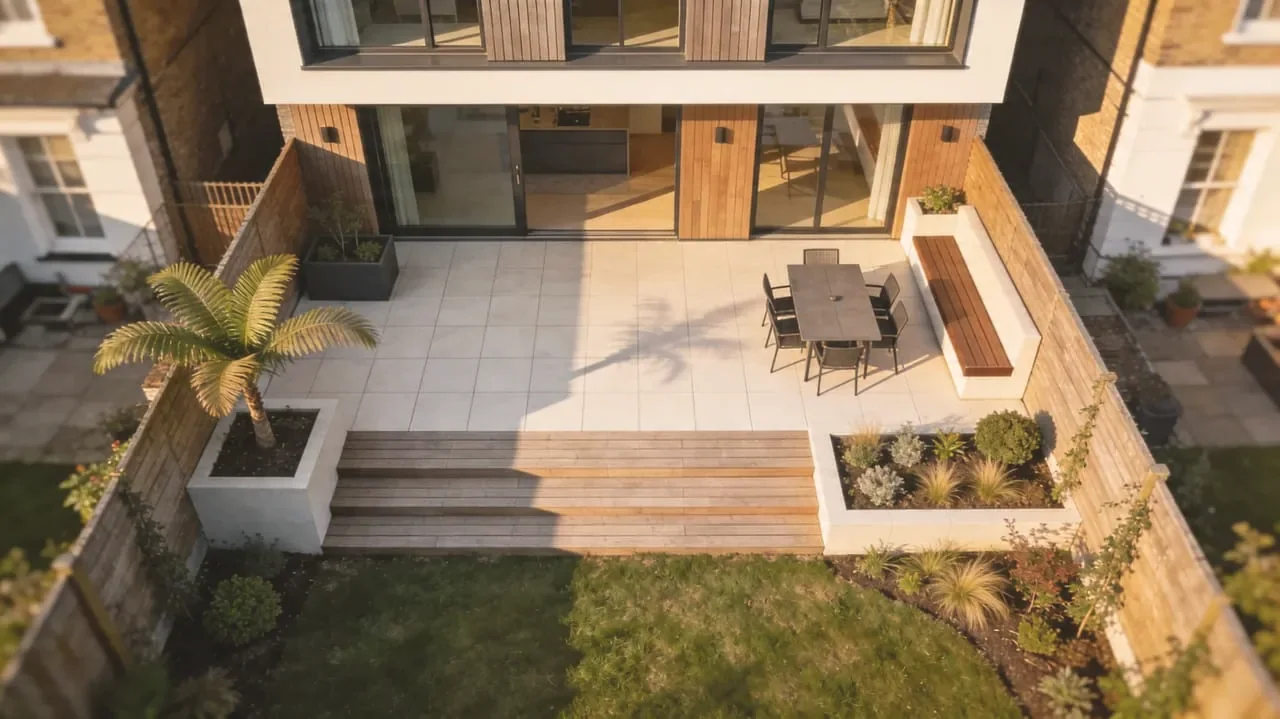
A side-return extension is, pound for pound, the single change that does most for a London terrace — and the floor area it adds is almost beside the point. Filling the narrow alley beside the rear of the house gains only six to twelve square metres, but opening up the old side wall converts a tight galley into a wide, daylit kitchen-diner. Expect to pay roughly £2,200 to £3,700 per square metre on the build, which for a typical 8–10 m² infill with a new kitchen lands around £56,000 to £88,000 all-in for 2026. This guide makes the value case, sets out the three things that actually drive the price, and gives you one worksheet that includes the fees most quotes leave off.
Why the maths works — small footprint, big change
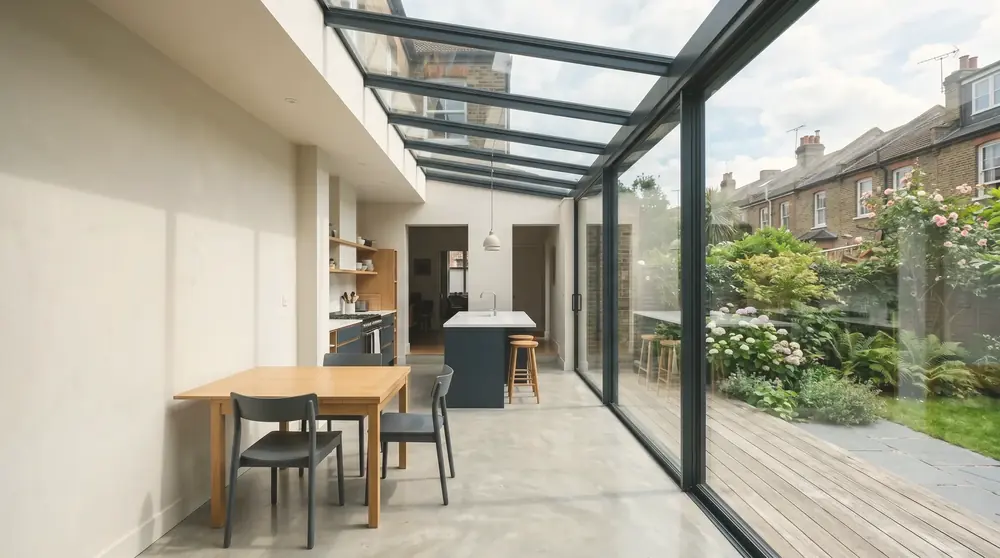
The headline square metres mislead people. A side-return only annexes the thin strip of land — most often a metre and a half to two and a half wide — that Victorian builders left down one flank of the rear outrigger for access and bins. On its own that's a modest gain. The change comes from what you do alongside it: taking out the old flank wall of the back addition so the kitchen, the new infill and often the dining area read as one room. A standard terrace kitchen is around 2.8 metres wide; after the infill and the wall removal it's nearer 4.5 to 5 metres — enough for a full run of units, an island, and a table. Put a glazed roof at the junction and daylight floods the spot the house was always darkest. That spatial change, not the raw area, is what lifts both how the house lives and what it's worth.
The three things that set your price
Within the per-m² range, three decisions move the number more than any finish choice:
- The steel span. The side wall you're removing carries roof load and often the ends of the first-floor joists, so an engineer specifies a beam to bridge the new opening, bearing on padstones in the walls left standing. A longer or heavier span costs more steel and more careful installation — reckon on £3,200–£7,000 for the engineering, fabrication and fitting.
- The roof and its glazing. This is the biggest single swing in the spec. A thermally broken aluminium lantern spanning the whole infill costs £4,200–£9,200 supplied; a flat roof carrying one or two rooflights over a quality liquid-applied membrane comes in lower; a mono-pitch tiled roof removes the leak risk at the price of less light. Glazed doors across the back wall add £6,000–£14,000. Daylight is what makes the room, so the roof is where the budget earns its keep — ahead of any upgrade to the worktop.
- The drainage. The soil pipe from the bathroom above nearly always tracks straight down the side return and needs diverting. Put it on the engineer's drawings and price it as its own line — allow £800–£2,500 — because a quote that says nothing about it is one to question.
Does it need planning permission?
Usually not. A single-storey side-return infill normally falls within permitted development on a London terrace — kept under the height limits, not projecting past the front of the house, with materials resembling the existing. But the common London exceptions switch that off: a conservation area (which covers a great many inner-London terraced streets, and where a side extension visible from the road draws scrutiny), an Article 4 direction that has stripped permitted-development rights from your street, or a listed building (which needs consent whatever the size). Flats get no permitted-development rights at all. Where it does qualify, a lawful development certificate (a £103 fee) gives you written proof and smooths a future sale. Before any drawings are paid for, we check your address against the planning record, so you don't design something the council will turn down.
Party wall comes with the territory
Almost every side-return triggers the party-wall process, because the infill sits on the boundary and the new foundations go in right beside the neighbour's — and the work usually cuts into, or runs hard against, the shared wall. Notice has to be served before work starts; the neighbour then has a fortnight to agree, or to dissent and set a surveyors' award in motion. Where they bring in their own surveyor you cover both bills — set aside £700–£1,500 for each adjoining owner. The practical rule: serve the notice the day the design is locked, not the week the build is due to begin, because a contested agreement can add six to eight weeks to the run-up. The full mechanics are in our party-wall guide.
Foundations and the structural reality
Two ground facts move the cost. First, the new foundations have to sit deeper than the shallow Victorian originals — typically down to 1.2–1.5 metres, and deeper still on the London clay near mature trees, where the ground heaves seasonally. Second, the work happens in a confined strip with awkward access, which is precisely why a side-return runs at a higher rate per square metre than a straightforward rear extension: the steelwork is fiddlier and the labour slower in a space that narrow. Neither is a reason to avoid the project — they're reasons to have it engineered and priced properly rather than guessed.
The all-in worksheet
What trips up most budgets isn't the per-metre build cost at all — it's the ring of fees and site charges around it. Here's the full picture for a typical 8–10 m² infill, mid-spec, London 2026:
| Element | Typical 2026 cost | |---|---| | Engineer's calculations and drawings | £1,200–£2,500 | | Surveyor for the party-wall award (your share) | £700–£1,200 | | Stripping out and groundworks | £5,000–£9,500 | | Steel beam, supplied and fitted | £3,200–£7,000 | | Brick and block to the new walls | £4,000–£7,500 | | The roof: lantern, or membrane with rooflights | £4,500–£10,500 | | Glazed rear doors (bifold or sliding) | £6,000–£14,000 | | First fix — pipework and wiring | £4,000–£8,000 | | Plaster, screed and decoration | £3,500–£6,500 | | New kitchen, mid-spec | £18,000–£30,000 | | Everything in (build plus kitchen) | £56,000–£88,000 |
Opt for premium glazing, a bespoke kitchen or awkward drainage and the top figure climbs toward £95,000–£112,000; the build on its own, kitchen set aside, sits nearer £40,000–£62,000.
The mistake that wrecks the budget: forgetting the kitchen
A side-return ends, almost without exception, in a new kitchen — you've stripped the old one to the shell to do the work, so reinstalling it makes no sense. Yet the kitchen is the line that gets treated as an afterthought: the structure is priced in detail, the kitchen is "we'll sort that later," and then the kitchen quote arrives and the budget's gone. Decide the kitchen scope and its budget before the build is programmed, and bear in mind that bespoke or semi-bespoke cabinetry carries a lead time of eight to fourteen weeks — order it early so it's ready when the room is. The other recurring errors are cheap roof glazing at the most exposed junction in the build, and ignoring the soil-stack diversion until it appears as a surprise.
Timeline
A clear run, no planning application needed: about 18–22 weeks from survey to handover. Add roughly eight to ten weeks where a conservation-area application is required, and six to eight more should a neighbour object under the party-wall process. The on-site construction itself is 12–16 weeks; design, structural calculations and notices take four to six up front, and the kitchen fit-out and snag close it out in two to three. As ever on structural work, the steel is the long-lead item — ordered the moment the design is fixed, so the beam is on site by the time the build reaches that stage.
Closing CTA
A side-return can't be priced from a photo — the steel span, the ground, the access and the drainage all decide the figure. PrimeCraft Surface Solutions looks over the rear of the house, brings in an engineer for the opening, and comes back with a trade-level quote that breaks out the structure, the roof, the glazing and the kitchen as separate lines, with dates set in advance and one contact throughout. Our work runs throughout London and out into the home counties beyond. Arrange a free site visit, or pull a first range off the estimator.