Open-plan kitchen extension: is it worth it in London (2026)?
A straight answer on whether an open-plan kitchen extension is worth it in London — the cost gap, the structural reality, the value added, and the downsides.
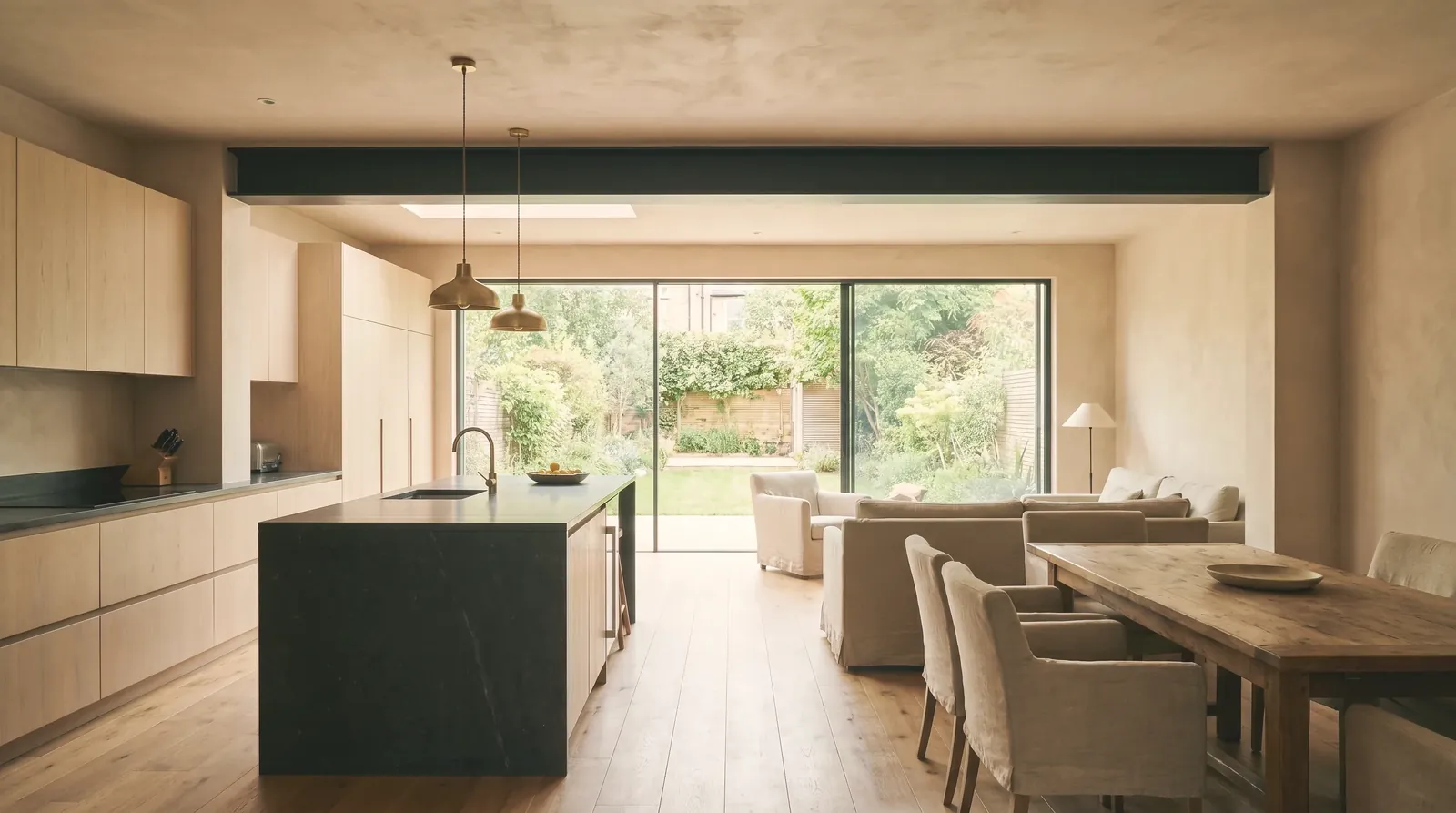
For most London terraces and semis, an open-plan kitchen extension is worth it — but only when you actually want the rear of the house to work as one connected space, and only when the build is done properly. Expect it to cost meaningfully more than a kitchen refit alone, because you're adding floor area and removing a structural wall, and expect it to add value where open-plan living suits the local market. This guide gives the honest verdict: the cost gap, the structural reality, the glazing choices, what it adds on resale, and the downsides nobody volunteers.
What "open-plan kitchen extension" actually means
It's usually one of three moves, or a combination. A rear extension pushes the back of the house into the garden and opens the new space into the existing kitchen. A knock-through removes the wall between the kitchen and an adjoining room — often the old dining room — to make a single kitchen-diner. A side-return infill fills the alley beside a terrace and widens the whole ground floor. Many London projects do two at once: a rear extension plus the removal of the spine or rear wall, so the kitchen, dining and living areas read as one room with light from the garden and from above.
The cost gap: extension vs a kitchen on its own
A kitchen refit in the same layout is one cost. An open-plan extension is that kitchen plus three things: the new floor area (priced per square metre — see our extension cost guide for the rates by type), the structural opening, and the glazing. The structural opening is the line people underestimate. Taking out a wide rear or spine wall means a steel beam sized by an engineer, sitting on padstones in the remaining walls, with Building Control sign-off before it's covered: budget £6,500–£13,000 for the engineering, the steel and the installation on a typical wide span.
So the honest framing is: you are not paying "a bit more than a kitchen." You're paying for a kitchen, an extension and a structural alteration, as one project. The upside is that doing them together is far cheaper and less disruptive than doing them as three separate jobs a few years apart.
The structural reality
The back wall of a London terrace is usually load-bearing — it carries the floor above and often part of the roof. Removing it is routine for an experienced builder, but it is a Building Regulations matter under Part A, not a casual knock-through. A structural engineer specifies the beam; the beam is propped in temporarily while the wall comes out; Building Control inspects before anything boards it over. If steels go into a party wall, the Party Wall Act applies and notices are served on the neighbour first. None of this is a reason not to do it — it's a reason to use a builder who treats the steelwork as the core of the job, not an afterthought.
Glazing: where the light (and a chunk of the budget) comes from
Open-plan living lives or dies on light, so glazing is a real line, not a detail:
- Bifold or sliding doors across the rear wall connect the room to the garden. Supplied and fitted, quality aluminium systems (Schüco, Origin and similar) run £6,000–£14,000 depending on width and specification.
- A roof lantern or large rooflight over the deepest part of the plan puts daylight where a terrace is naturally darkest. A lantern runs roughly £3,500–£9,000 supplied and fitted; a single fixed rooflight far less.
All new glazing has to meet the Part L whole-unit U-value of 1.6 W/m²K, which any decent modern unit clears. Spend here before you spend on a fancier worktop — the light is what makes the room feel transformed.
Does it add value in London?
Generally yes, with a caveat. Savills research has put the uplift from a well-judged open-plan reconfiguration at around 3–8% of a London property's value. On top of that, an open-plan kitchen-diner is what a large share of London buyers actively want, so it widens your buyer pool as well as adding floor area.
The caveat is the market and the family question. In some prime family postcodes, buyers value a separate, closeable kitchen and a formal room; a fully knocked-through ground floor can narrow rather than widen appeal. Check what's selling on your street before you commit to removing every wall.
The downsides nobody volunteers
A good builder tells you these before you start:
- Heat and noise travel. One big space is harder to heat zone-by-zone, and cooking smells and noise carry into the living area. Underfloor heating and a strong, quiet extractor matter more in open-plan than in a closed kitchen.
- Less wall and storage space. Knocking through removes walls you might have wanted for units, shelving or a sofa.
- It's not for every household. Families with teenagers sometimes miss having two separate rooms. Be honest about how you actually live.
None of these kills the idea. They just mean the design has to account for heating, ventilation and storage from the start — which is exactly what gets skipped when the focus is only on the wow factor.
How to get a real number
An open-plan extension can't be priced over the phone, because the cost turns on the span of the wall coming out, the ground conditions for the new foundations, and the glazing you choose. Have a rough floor-area target, a sense of your finish level, and your conservation-area status to hand. We survey the structure, get the engineer's view on the opening, and come back with a line-by-line quote that separates the build, the steel and the glazing so you can see exactly where the money goes — and where you could trim it.
Closing CTA
PrimeCraft Surface Solutions designs, manages and builds open-plan kitchens and extensions across London and the surrounding Home Counties — engineer-led on the structure, with a line-by-line quote, fixed dates in writing, and one project manager from survey to handover. Book a free site visit, or start with the online estimator, and we'll tell you what's possible and what it costs.