Engineered oak, solid wood or LVT? Choosing a London floor (2026)
Four questions that pick the right floor for a London home: engineered oak, solid wood, LVT or laminate, with the 2026 costs and specs.
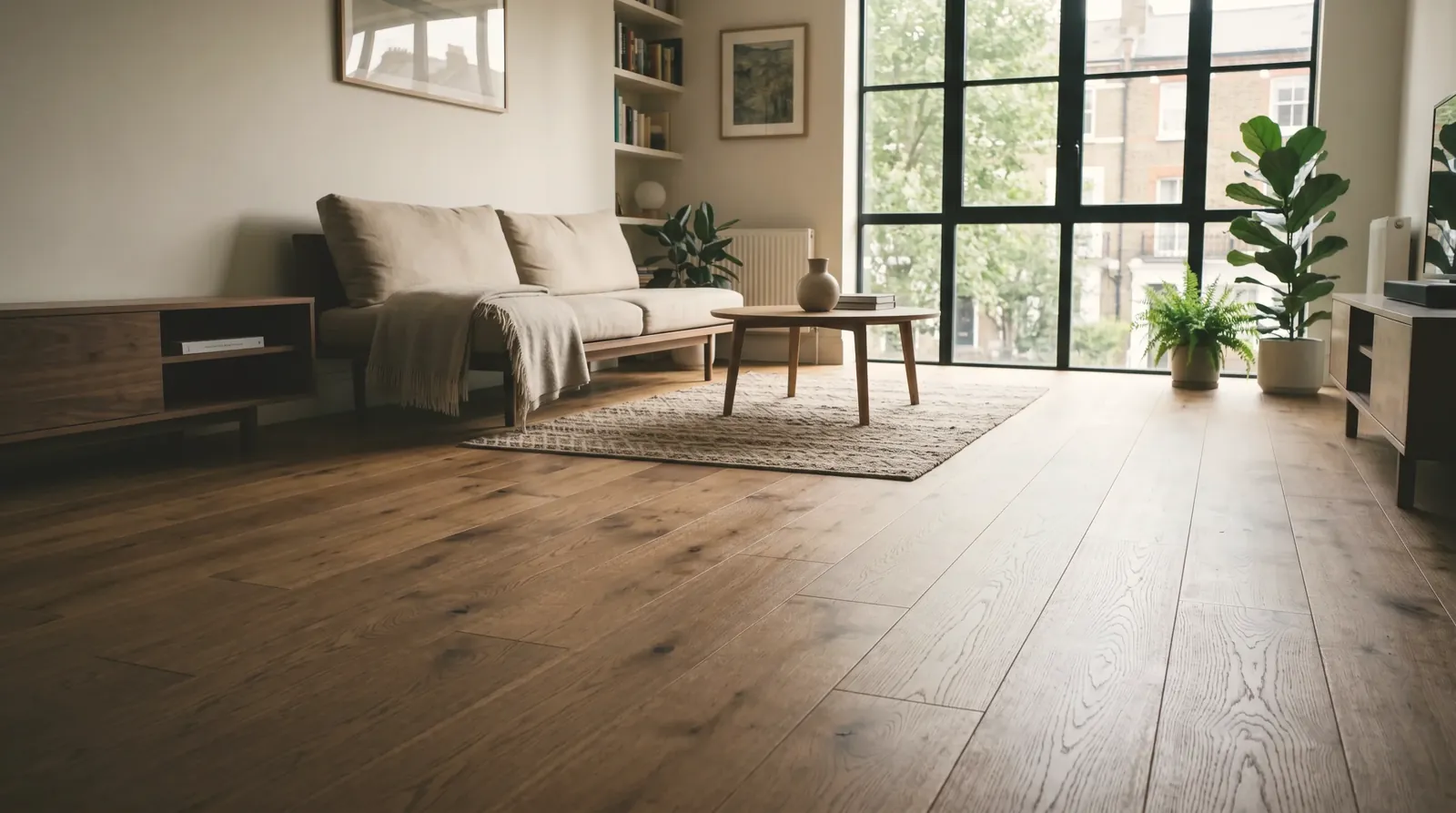
The right floor for a London home comes down to four questions: do you have underfloor heating, is water a risk in the room, do you want genuine period character or hard-wearing practicality, and how long are you staying? Answer those and the choice between the four real options — engineered oak, solid timber, LVT and laminate — makes itself. As a quick steer: engineered oak is the sensible default for most London rooms, solid wood is for period homes where character beats convenience, LVT wins in bathrooms, kitchens and busy family floors, and laminate is a false economy almost everywhere. This guide runs the decision, compares the four at a glance, and sets out the three spec numbers that decide whether you love the floor in three years or replace it.
Start here: four questions
Run these in order and they'll point you to a material before you look at a single sample:
- Is there underfloor heating, now or later? If yes, rule out solid wood — most makers void the warranty over UFH because it moves too much. Engineered oak and LVT both handle heated floors well.
- Is water a real risk in the room? Bathrooms, utility rooms and the splash zone of a kitchen want something genuinely waterproof. That's LVT or tile, not wood of any kind.
- Period character or practicality? If the property's character — and its resale to character-buyers — matters more than easy upkeep, real wood (solid or engineered) earns its place. If a family, pets and spills are the daily reality, practicality should win.
- How long are you staying? A long-term home justifies a floor that can be sanded back and refreshed for decades. A shorter hold, or a rental, points to a resilient, lower-cost surface.
The four options, at a glance
| Floor | Best for | Takes UFH? | Refinish? | Typical 2026 cost, supplied and laid | |---|---|---|---|---| | Engineered oak | Most London rooms; the default | Yes | A few times, if the wear layer is thick enough | £72–£170/m² | | Solid wood | Period homes, upstairs rooms, character | Generally no | Many times; lasts lifetimes | £115–£270/m² | | LVT | Bathrooms, kitchens, family floors, basements, rentals | Yes | No — worn out means replaced | £56–£122/m² | | Laminate | Tight budgets and short holds only | Some | No | Lowest, but short-lived |
All figures are London 2026 supply-and-fit ranges, narrowing at survey with the room, the subfloor and the board you choose.
Engineered oak — the default, explained
Engineered oak is a genuine oak wear layer bonded over a stable plywood or HDF core. The surface looks and wears like solid timber, while the layered core stays put through the humidity swings and the heated floors that make solid wood misbehave — which is why it's the right answer in most London rooms outside the wet ones. The number that matters is the wear layer: under 3 mm and you'll get one refinish or none; specify at least a 4 mm wear layer on a board of 15 mm or more and you keep the option to sand it back two to four times over its life. Quality spans an enormous range here — there's £40/m² engineered and £180/m² engineered — and the difference is real, so it's the one place not to buy on price alone.
Solid wood and LVT — the two specialists
Solid wood is exactly that — one solid board of hardwood, oak more often than not — and nothing matches the patina it develops or the value it adds to a period home; buyers notice. The trade-offs are real: it generally can't go over underfloor heating, it expands and contracts visibly with the seasons (gapping in winter, cupping in summer over the wrong subfloor), and it needs a week or two acclimatising in the room before it's laid. Keep it to upstairs rooms and character spaces where practicality isn't the priority.
LVT — luxury vinyl in plank or tile form — deserves more respect than it gets. It's genuinely waterproof, takes underfloor heating happily, feels warmer underfoot on a concrete slab than tile, lays fast and often over an existing subfloor, and a good one is hard to tell from engineered wood in a photo. Its limits: a close look reveals the repeating pattern, heavy furniture can dent it, it can't be refinished, and the plastic has a worse environmental footprint than wood. In a family kitchen, a bathroom or a basement flat, it's frequently the smartest choice on the floor.
The spec details that decide whether you regret it
Whatever you choose, three things separate a floor you're happy with from one you fight:
- The subfloor. Wood and LVT both need a flat, sound, dry base; laying a quality board over a poor subfloor wastes the board. Screed and substrate prep belong in the quote, not as a surprise.
- Acclimatisation and moisture. Real wood has to sit in the room to adjust before it's fitted, and a concrete slab needs its moisture checked first — skipping either is how floors gap, lift or cup later.
- Movement and edges. Floors need expansion gaps at the perimeter, hidden under skirting or beading; a floor laid tight to the walls has nowhere to go when it moves. On a heated floor, follow the maker's maximum surface temperature so you don't cook the boards.
Get the material right but the spec wrong and you'll still be disappointed — which is why the fitting detail matters as much as the choice.
Closing CTA
The floor that's right for your home depends on the room, the subfloor and how you live in it — so it's worth getting the spec checked before you order. PrimeCraft Surface Solutions surveys the substrate, recommends the material and the wear-layer or thickness that fits the room, and lays it with the prep and the expansion detail done properly — throughout London and the counties beyond. Book a free flooring survey, and we'll match the floor to the room rather than to a sample board.