Renovating and extending a North London home (2026): the practical guide
A place-led guide to renovating and extending in North London: period terraces, conservation areas, party walls, and 2026 costs by postcode.
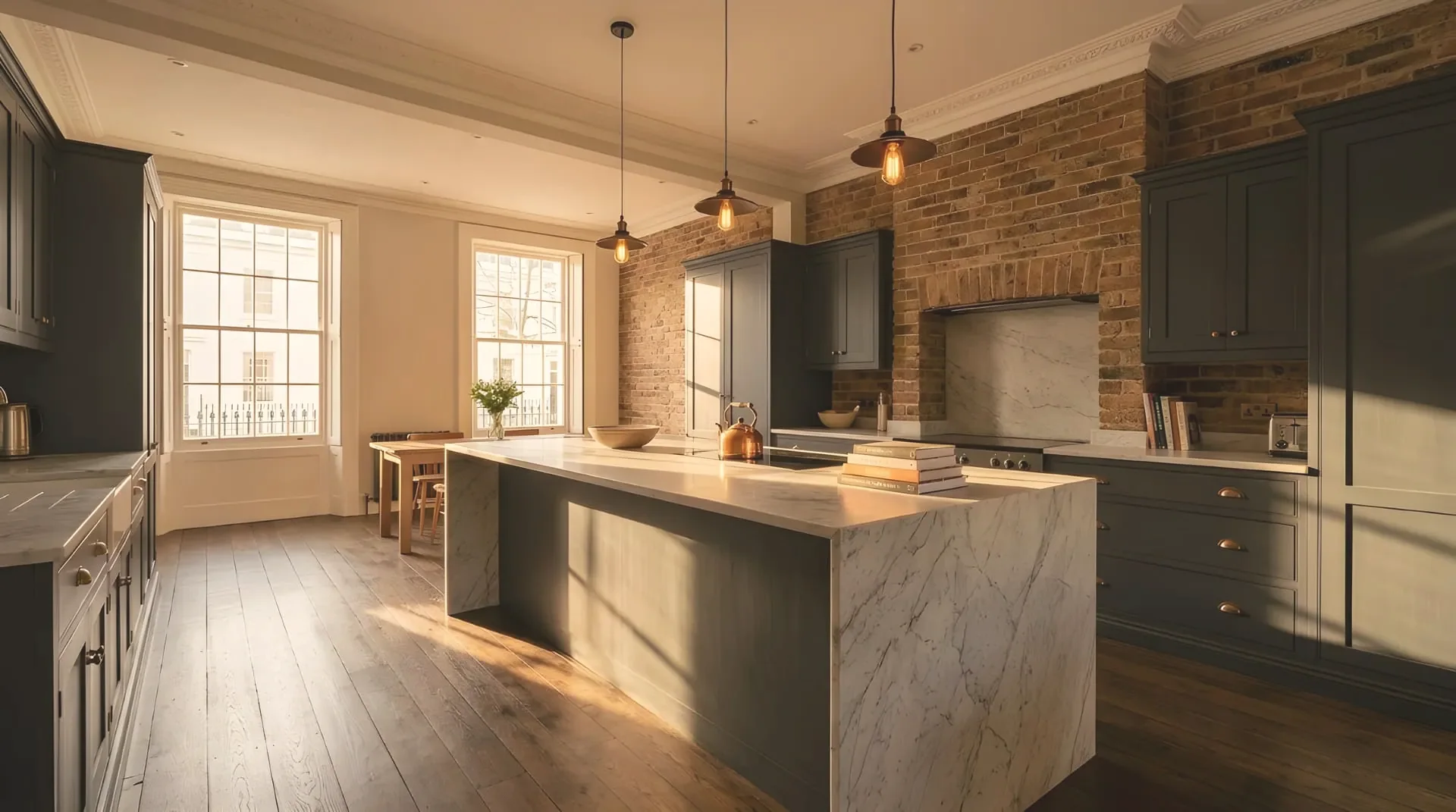
A full renovation of a North London Victorian terrace in 2026 typically costs £950 to £1,450 per square metre — meaning a 90 m² mid-terrace runs around £85,000 to £130,000 before extensions, loft conversions or basement work are added to the programme. The figure is higher than a generic London average for a concrete reason: North London's housing stock — Georgian squares in Barnsbury (N1), Edwardian terraces in Highbury (N5), large Victorian semis in Hampstead (NW3) and Belsize Park (NW3), and Arts and Crafts detacheds up on Highgate (N6) and Muswell Hill (N10) — demands more preparation, more careful structural work, and more conservation compliance than a postwar semi anywhere else in the capital. This guide sets out the practical cost and programme realities borough by borough, covers the planning and party-wall steps you will almost certainly encounter, and gives you the full-cost picture across the most common renovation projects.
Why North London's housing stock is a different build
North London contains one of the highest concentrations of pre-1919 housing in England. The majority of occupied homes across Camden, Islington and Haringey were built between the 1820s and 1910, which means three things that directly affect what a renovation costs and how long it takes.
The structure needs modern services routed through it. A four-storey Barnsbury terrace (N1) built in the 1830s was designed for gaslight and coal fires. Routing a modern electrical installation, replacing cast-iron waste stacks, and adding a new boiler and heating upgrade while preserving original cornices, sash windows and lime plaster takes time that a brick box from the 1970s doesn't. The strip-out itself is measured and selective rather than wholesale, which is slower. Across Islington and Barnsbury, full renovation budgets on four-storey Georgian terraces run £320,000 to £660,000 for this reason — the floor area is large and the services component is proportionally bigger than the spec alone would suggest.
The ground creates surprises. London clay is the substrate under most of North London, and mature street trees in areas like Highgate (N6), Holloway (N7) and Crouch End (N8) cause seasonal heave. New foundations for extensions or basements need to go deeper than the originals — typically to 1.5 metres or beyond, and sometimes to 2.5–3 metres in the influence zone of a large tree. This adds excavation time and cost that is invisible at the design stage but very visible in the final invoice. Any quote that doesn't address foundation depth for an extension on a tree-lined North London street deserves a closer look.
Conservation coverage is the rule, not the exception. Across N1, N6, NW3, NW5 and NW8, the majority of period streets are either inside a named conservation area or affected by an Article 4 direction that removes some or all permitted-development rights from houses. In Camden alone there are more than thirty conservation areas, covering streets from Primrose Hill (NW1) through Belsize Park (NW3) to Hampstead village and the south edge of Hampstead Heath. Haringey covers the Highgate Conservation Area across much of N6, and Islington protects most of the Barnsbury, Canonbury and Highbury Fields stock. The effect on your project is practical: permitted development that would be automatic on a postwar terrace in outer London may need a full planning application here, and certain external materials — sash window profiles, brick colour and mortar specification — are conditions, not suggestions.
What drives the price in North London
Across the borough spread from N1 to NW11, four variables move the renovation or extension budget more than anything else.
1. The scope of services work. In any pre-1919 terrace, the cost of re-running electrical wiring, replacing lead or cast-iron water pipes, and upgrading drainage is a fixed overhead that doesn't scale with kitchen or bathroom spec. On a two-bedroom Kentish Town (NW5) terrace the services element is a significant proportion of a £95,000–£140,000 whole-house renovation; on a full four-storey Highbury (N5) house with a basement it dominates the programme. Getting this costed properly at the survey — as a separate line from the finishes — is the clearest sign a quote is based on the real building rather than a rate card.
2. Floor count and access. The tall Georgian terraces on the Barnsbury squares (Lonsdale Square, Milner Square, Barnsbury Square — N1) and the four- and five-bedroom semis in St John's Wood (NW8) and Hampstead (NW3) have more floors to work through, and first-floor or upper-floor extension options like mansard conversions become serious cost lines. Working up a stairwell on a listed building adds time to every trade. By contrast, the two-storey Victorian terraces in Holloway (N7), Stoke Newington (N16) and Archway (N19) are more straightforward floor-by-floor, even where conservation restrictions apply above.
3. The extension type. A single-storey rear extension on a Victorian terrace — the most common project across N5, N7, NW5 and N16 — runs £2,100 to £3,600 per square metre for the shell. That's per square metre added, not of the whole house, and a typical 15–25 m² addition comes in at £40,000 to £90,000 for the structure before the kitchen. A loft conversion (rear dormer, which is the standard form for a terraced house in this part of London) adds £58,000 to £88,000 all-in on a terrace; on a larger semi or detached home in NW3, N6 or NW11 the figure rises to £75,000 to £120,000 because the structural work is heavier and the dormer faces more conservation scrutiny.
4. Conservation and planning costs. A planning application adds £2,500 to £5,500 in professional fees (design, drawings, planning agent if needed) and eight to fourteen weeks of time. Where permitted development applies but you want written proof for a future sale, a lawful development certificate costs £103 in council fees and a straightforward application. If the project is in a conservation area and needs a heritage statement, add another £800 to £2,000. These are real costs that belong in every budget from day one.
Planning and conservation: what to expect
Most rear extensions on terraced houses in N7, N8, N16 and N19 are permitted development: single storey, no higher than the eaves, not extending past the rear wall by more than eight metres (six on a mid-terrace). That's the general rule, and in a good number of cases it holds.
The exceptions are common enough in North London that they deserve naming. An Article 4 direction — in place across most of Islington and many streets in Camden — means the council has removed permitted development rights, often because the street-pattern or architectural character is considered worth protecting. Your address determines whether it applies; it isn't a borough-wide switch. The check takes five minutes on the council planning portal, and doing it before committing to a design saves significant wasted spend. We run it at every survey.
Conservation area status, separate from Article 4, controls external works on the building's character: replacement windows have to match the originals, front elevations are regulated, and extensions visible from a public highway draw more scrutiny. Inside a listed building (there are hundreds across Camden, Islington and Haringey, from individual Highgate houses to whole Barnsbury square terraces) consent is needed for any work that affects the original fabric, internal or external. The process is longer and the conditions more detailed, but listed building consent is routinely granted for well-designed kitchens, bathrooms and sympathetic loft conversions — it is not a refusal by default.
Permitted development loft conversions have specific volume limits: 40 cubic metres for a terraced house and 50 cubic metres for a semi-detached or detached. These figures are the cumulative total added to the original roof space, including any previous work. Go over the limit, or apply within a conservation area where PD rights have been removed, and you need planning permission. A structural engineer's drawings and a fire-strategy note are part of any loft submission either way.
The party-wall reality
Almost every rear extension and most loft conversions in North London require party-wall notices to one or more neighbours. The rules are straightforward and the timeline is fixed: notice has to be served before structural work begins, the neighbour has fourteen days to respond, and if they dissent (or don't respond), a surveyor's award must be agreed before work can start. Where the neighbour instructs their own surveyor you typically cover both sets of fees — allow £700 to £1,500 per adjoining owner, and more where the work is more complex. The full mechanics are in our party-wall guide.
The practical consequence is a programme note: party-wall notices need to go out the day the design is finalised, not the week the build is due to start. A dispute that goes to an award adds six to eight weeks to the pre-start period. On North London's dense terraced streets — Barnsbury (N1), Kentish Town (NW5), Highbury (N5), Kilburn (NW6) — where houses share walls on both sides and rear gardens often back onto another terrace's gardens, you may need to notify three or four separate parties. This is normal. It is also reason to start the administration early.
All-in cost table: North London 2026
The table below covers the most common project types across the North and North-West London postcode spread. All figures assume mid-specification work in 2026 London rates.
| Project type | Typical postcode areas | 2026 cost range | |---|---|---| | Whole-house renovation, 2-bed Victorian terrace (85–95 m²) | N7, N8, N16, N19, NW5, NW6 | £80,000–£140,000 | | Whole-house renovation, 3–4-bed Victorian/Edwardian terrace (110–135 m²) | N5, N16, NW5, NW6 | £105,000–£195,000 | | Whole-house renovation, Georgian terrace 4 storeys (200–300 m²) | N1 Barnsbury/Canonbury, NW1 Primrose Hill | £320,000–£660,000 | | Whole-house renovation, large Victorian/Edwardian semi (180–250 m²) | N6, N10, NW3, NW11 | £220,000–£420,000 | | Rear single-storey extension (15–25 m²), shell only | N5, N7, N8, NW5, N16 | £40,000–£90,000 | | Rear single-storey extension + new kitchen | N5, N7, NW5 | £65,000–£120,000 | | Loft conversion, rear dormer, terraced house | N1, N5, N7, N8, N16, NW5, NW6 | £58,000–£88,000 | | Loft conversion, rear dormer or hip-to-gable, semi/detached | N6, N10, NW3, NW8, NW11 | £75,000–£120,000 | | Kitchen renovation (existing space, no extension) | All North London areas | £18,000–£45,000 | | Bathroom renovation | All North London areas | £10,000–£28,000 | | Basement dig-out + tanking (existing lower-ground floor) | N1, N6, NW3, NW8 | £55,000–£140,000 |
Extensions in conservation areas often carry a 5–10% planning premium (fees, heritage statement, longer design period) on top of the above. Basements require structural engineering from the outset and the cost range reflects real variation in ground conditions — London clay at depth and tree root influence zones are the main variables.
FAQ
How much does it cost to renovate a Victorian terrace in North London in 2026? A mid-spec whole-house renovation of a two- to three-bedroom Victorian terrace in North London — rewire, replumb, new kitchen, new bathroom, replastering, flooring — runs roughly £950 to £1,450 per square metre in 2026, putting an 85–95 m² house at £80,000 to £140,000 before any extension or loft work. Higher specs (stone, bespoke joinery, underfloor heating throughout) push toward £1,600–£2,000/m². The services element (electrical, plumbing, drainage) is the least flexible cost line on any pre-1919 building regardless of how the finishes are specified.
Do I need planning permission for a rear extension on a North London terrace? Often no — a standard single-storey rear extension within the permitted-development size limits (no more than six metres from the rear wall on a mid-terrace, four metres high or lower) is permitted development on most North London houses. But Article 4 directions in Islington, parts of Camden, and several Haringey streets remove those rights on specific addresses, and a conservation area adds scrutiny to any external change visible from a public road. We check your address against the planning register at the survey, so you know the route before any design fees are committed.
What is the planning rule for a loft conversion in North London? A rear-dormer loft conversion is permitted development on a terraced North London house provided the volume added to the original roof space does not exceed 40 cubic metres — or 50 cubic metres on a semi-detached or detached property. Exceeding those limits, sitting inside a conservation area where PD rights have been removed, or working on a listed building all require a planning application. In the Hampstead Conservation Area (NW3) and the Highgate Conservation Area (N6), planning consent is the norm rather than the exception. A structural engineer's drawings and a fire strategy note accompany every application.
How long does a North London renovation take? A whole-house renovation of a two-bedroom Victorian terrace, starting on site, takes about 16 to 24 weeks. Add an extension to the programme and it's typically 22 to 32 weeks from start to handover. A combined renovation, rear extension and loft conversion on a three- to four-bedroom house — one of the most common sequences in N5, NW5 and N16 — is normally 30 to 40 weeks on site, with the planning and party-wall pre-start period adding a further 10 to 20 weeks depending on the route. The combined programme for a Georgian terrace with basement work in N1 can run to 50–65 weeks from survey to completion.
Does a North London renovation need to comply with building regulations? Yes, and in most cases a structural renovation triggers a formal application — either full plans (submission and approval before work begins) or a building notice (notice given, inspection during the build). Extensions, loft conversions and any structural alteration require building control sign-off; so do boiler and electrical works beyond minor alterations. Building regulations approval and planning permission are separate processes, and you need both where both apply. We handle the building regulations application, and the final certificate is included in the project handover pack.
What's the most cost-effective renovation project in North London? A rear extension combined with a new kitchen refit delivers more floor area and usable change per pound than almost any other single project on a standard North London terrace. A 20 m² rear addition that opens up to a new kitchen-diner costs roughly £70,000 to £110,000 all-in — significant, but it transforms the ground floor of the house and adds to the value more reliably than a loft or basement at the same cost level. The loft conversion is the runner-up: less disruptive to daily life during the build, adds a bedroom and bathroom where they're often most needed, and on terraces in N5, N7, NW5 and N16 it usually qualifies as permitted development.
Which North London boroughs and councils are involved? Most North London renovation and extension work sits under three planning authorities: the London Borough of Islington (N1, N5, N7, N16, N19), the London Borough of Camden (NW1, NW3, NW5, NW6, NW8), and the London Borough of Haringey (N4, N6, N8, N10, N17). A smaller number of NW11 addresses fall under Barnet. Each authority has its own design guides, conservation area appraisals, and pre-application advice services. Knowing which council covers your address matters before any drawing is commissioned.
Closing CTA
Every number in this guide is a starting point, not a quote — the ground conditions under a Kentish Town (NW5) terrace, the listing status of a Highgate (N6) house, the drainage configuration on a Stoke Newington (N16) side return, and the conservation constraints on a Barnsbury (N1) Georgian square each push the real figure in a specific direction. A site visit is the only way to price them accurately.
PrimeCraft Surface Solutions works across North and North-West London — Islington (N1/N5/N7), Highgate (N6), Crouch End (N8), Archway (N19), Camden and Primrose Hill (NW1), Hampstead and Belsize Park (NW3), Kentish Town (NW5), Kilburn and West Hampstead (NW6), St John's Wood (NW8), and Golders Green (NW11) — and out across the wider home counties. We carry out a free site visit, produce a written itemised quote that prices the structure, the services, and the finishes as separate lines, and commit to a start date and a finish date before any work begins. One project manager handles the job from the initial survey to the final handover — there's no handoff once the build starts.
Arrange a site visit or pull a first-look range from our online estimator.