Loft conversion cost in London (2026): can your roof take one, and what it costs
What a London loft conversion costs in 2026 by type, £42,000–£170,000, starting with the head-height test that decides if it works at all.
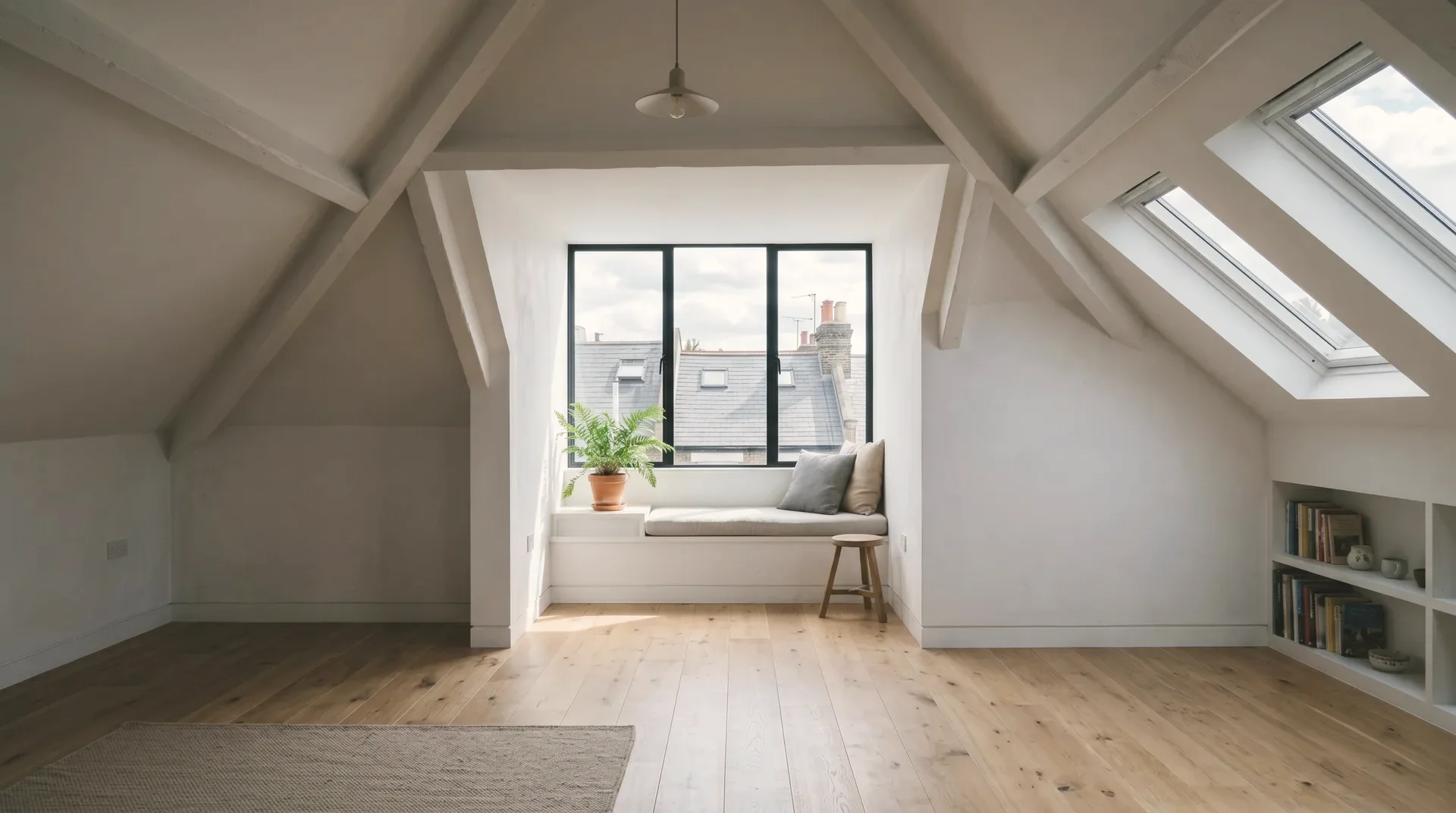
A loft conversion in London costs between £42,000 and £170,000 in 2026, depending on the type of roof you build. But before the price there's a cheaper question: does your roof have the head height to convert at all? Many London terraces don't have enough at the ridge without raising it, and that single fact decides whether you're looking at a simple rooflight job or a major structural one. This guide starts with that head-height test, then prices each conversion type by the bedrooms it actually buys you, then covers the fire-safety and services costs that catch people out. For when you need planning permission, we keep a separate loft-planning guide.
First: the head-height test
Stand in your loft and measure floor-to-ridge at the highest point. The finished room needs roughly 2.2–2.4 metres of usable height, and the conversion eats into the raw measurement — a new floor structure adds up from below, insulation and a ceiling take from above. As a working rule, you want around 2.5 metres or more of existing ridge height to get a comfortable room from a straightforward conversion. Less than that and your options narrow to the more structural (and pricier) types that raise or rebuild the roofline. It's worth knowing this before you fall for a layout, because no amount of design recovers head height the roof never had.
Cost by type — and by the bedroom it buys you
The four routes, priced for London 2026, with a note on what each actually adds:
- Rooflight (Velux) conversion — £42,000–£62,000. No change to the roof shape: skylights in, floor strengthened, staircase, insulation, electrics, plaster. Only works where the head height already exists, which is rare in a terrace without raising the ridge. Buys a single room cheaply when the roof allows it.
- Dormer conversion — £68,000–£98,000. A box pushed out from the rear slope to create standing room — the standard London conversion, usually a bedroom plus an en-suite on a Victorian or Edwardian terrace.
- Hip-to-gable — £78,000–£115,000. For a semi or end-of-terrace with a sloping side roof: the gable is built up to square off the roof, usually with a rear dormer added. More space than a plain dormer, and frequently a planning matter.
- Mansard — £105,000–£170,000. The whole rear slope is rebuilt as a near-vertical wall, giving close to a full extra floor — often two bedrooms and a bathroom. The biggest space gain, always a full planning application, and covered in depth in our mansard guide.
On a cost-per-bedroom basis a dormer is usually the sweet spot for one room; a mansard wins when you genuinely need two. Every range here is a 2026 London figure covering materials and labour, settled at the survey.
The compliance bill nobody quotes upfront
A loft turns the house into a three-storey home in the eyes of the regulations, and that brings costs that aren't about the room itself:
- Fire safety. A new habitable floor triggers a fire-protection upgrade through the whole house: mains-wired, interlinked smoke alarms; fire doors to the habitable rooms off the escape route; and a 30-minute fire-resisting ceiling to the floors below. Allow £3,200–£6,500 for that retrofit alone — it's compliance, not decoration, and it's mandatory.
- An en-suite up top. Putting a bathroom on the new floor — which most people want — adds £8,500–£15,000, and because it sits furthest from the existing soil stack it often needs a pumped waste run.
- The water system. If the house runs on a gravity-fed system with a cold tank in the loft, that tank is in the way and has to go — usually meaning a switch to a mains-pressure (unvented) setup, and an upsized boiler or new radiators to serve the extra floor.
- Structure. A loft puts weight onto a roof that was never built to carry it, so an engineer's structural calculations are needed under Part A regardless of the planning route — steels across the old ceiling joists are the norm, not the exception.
What pushes the price up or down
Within each type, the swing factors are predictable. Pushing it up: a conservation area or removed permitted-development rights (which force a full application — see the loft-planning guide), a listed building, heavy steelwork across the joists, relocating a soil stack or water tank, full-height glazing or a made-to-order staircase, and awkward scaffold access on a tight terrace. Pulling it down: existing head height that avoids raising the roof, no bathroom in the new room, a stock staircase, and a structure sound enough to carry the load without major steel. The single biggest swing is usually whether a bathroom goes in and how far it sits from the existing services.
Is it worth it?
In most of inner and mid London, a loft is among the strongest returns of any home improvement short of an extension. A well-built dormer adding a bedroom and en-suite typically lifts a terraced house's value by a multiple of its build cost in the higher-demand zones, and a mansard's two-room gain more again — though the uplift narrows further out, so check recent sale prices on your own street before committing. The other half of the sum is the alternative: moving to gain a bedroom in London carries stamp duty and fees that often dwarf the cost of converting the roof you already own.
Timeline
On-site weeks, materials ordered ahead of the start: a rooflight conversion runs 6–9 weeks; a rear dormer 10–14; a hip-to-gable 12–16; a mansard 12–18. Before any of that, design and consents take 4–8 weeks, and where a neighbour dissents the party-wall route adds at least a couple of months on a terrace by itself. The usual cause of a slipped start is structural steel — three to five weeks from order — which is why the steel goes on order the moment the design is fixed, not when the beam is wanted on site.
Closing CTA
Whether a loft is even worth designing comes down to head height, structure and access — a half-hour on site answers it faster than weeks of reading. PrimeCraft Surface Solutions checks the feasibility first, manages the structural design, fire compliance and any application, and returns a trade-level quote with dates fixed up front and one point of contact throughout, across Greater London and the counties around it. Arrange a no-cost assessment, see how a loft sits inside a wider home renovation, or run the numbers through the online estimator for an opening figure.