Boiler replacement cost in London (2026): the real all-in price
A new boiler in London is £2,500–£5,500 installed in 2026 for most homes. The honest all-in price by type, and the four line items that decide whether it lasts.
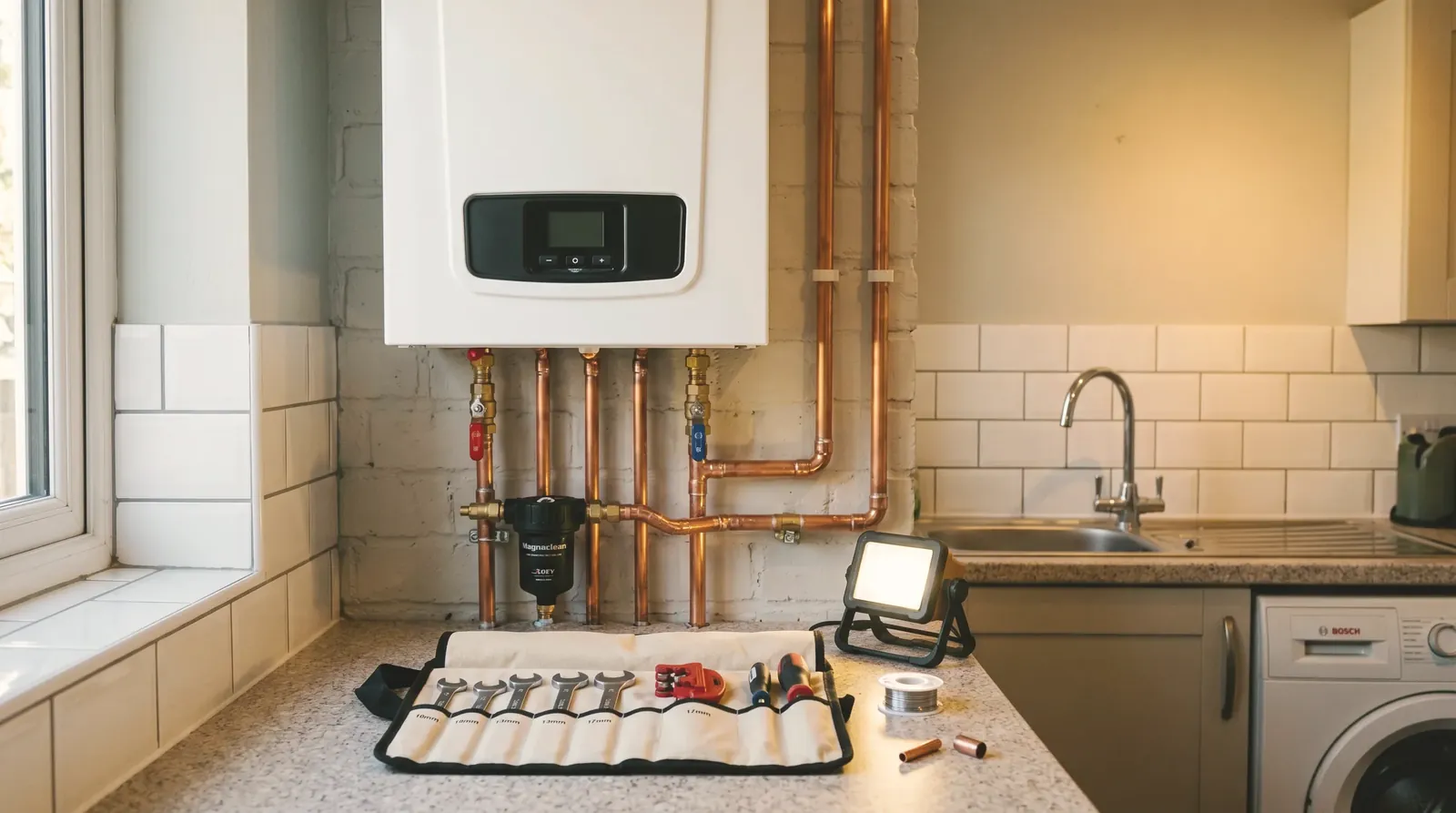
Replacing a boiler in London costs £2,500 to £5,500 installed for most homes in 2026, with system-and-cylinder jobs running higher. The headline price is rarely the issue, though — two quotes for the "same" swap can sit £1,500 apart, and the gap is almost never the boiler itself. It's four supporting line items that decide whether the new unit lasts ten years or five, and whether its warranty is even valid. This guide gives the honest all-in price by boiler type, then those four items in plain terms, then how to check the engineer and read the quote before you sign.
What it costs, installed, in 2026
All figures below are the complete job — the unit, the flue, the condensate run and the legally required commissioning certificate included:
- Budget combi (28–30 kW, entry Worcester or Vaillant): £2,500–£3,400.
- Mid-range combi (30–35 kW, Worcester Greenstar or Vaillant ecoTEC plus): £3,100–£4,400.
- Premium combi (Viessmann, Vaillant ecoTEC Exclusive): £3,900–£5,500.
- System boiler, reusing a sound existing cylinder: £2,900–£4,700.
- System boiler with a new unvented cylinder: £5,600–£9,200 for the pair.
- Heat-only replacement on an existing gravity system: £2,300–£3,600.
Switching between boiler types — combi to system, say — adds £500–£1,500 in pipework and system changes. That can be the right move for the property, but only when the household and the hot-water demand actually call for it, not because it was suggested at the door.
Which boiler suits the home
Quick orientation before the price:
- A combi heats water on demand with no cylinder, and suits most London flats and two-to-three-bed houses with a single bathroom. Its flow drops when two outlets run at once, so a busy household with several bathrooms can outgrow it.
- A system boiler pairs with a separate unvented cylinder and serves a larger home with multiple bathrooms running together; it needs a cupboard for the cylinder.
- A heat-only (regular) boiler is the traditional cylinder-and-loft-tank setup still common in older London houses; a like-for-like swap is the cheapest route when the rest of the system is healthy.
The four line items that decide the price (and the lifespan)
This is where the £2,200 job and the £3,800 job diverge. None of these four is optional on an installation meant to last:
- A system flush. A new boiler dropped into a system full of old sludge circulates that grit through its heat exchanger from the first firing — and most manufacturers void the warranty if contaminated water is found. A powerflush runs £320–£720 and is effectively mandatory on any system more than a few years old.
- A magnetic filter (Adey or Fernox). Around £100–£200 fitted, it catches the iron oxide that forms over time before it reaches the new unit. Most warranties now require one.
- A scale reducer. London is a hard-water city, and £100–£200 of scale protection guards the heat exchanger that scale otherwise eats within a few years.
- Warranty registration and a commissioning record. Some installers leave without registering the boiler or logging the commissioning figures; the homeowner assumes a ten-year warranty is live when it isn't, and a future claim can be refused for want of that record.
The difference between a bargain quote and a sound one is usually these four — a few hundred pounds of parts and labour that quietly decide whether the boiler reaches its tenth birthday.
What a proper installation actually includes
Beyond the box on the wall, a complete job runs: draining the system and lifting out the old appliance; mounting the new boiler with its bracket, connections and a condensate run to a drain or soakaway; fitting or re-routing the flue to meet current clearances; flushing the system before the new unit fires; commissioning it — setting the gas pressure, verifying flow temperatures, pairing the controls — and issuing the certificate the law requires; then a handover walkthrough, the manual left behind, and the warranty registered that day. A job that skips the commissioning record, or hands the warranty registration back for you to chase, is cutting a corner that bites later.
Flue and controls — the two add-ons worth understanding
Building Regulations Part J requires a flue to end in an approved position, holding set distances from openings and corners. A fresh flue route is needed where the present one falls short of those rules, where the boiler moves to another room, or where you change boiler type; relocating it adds £320–£920 according to the run length and whether it leaves through a wall or the roof. Ask for it as its own line so it can be checked.
On controls, the protocol matters more than the badge. An OpenTherm-capable thermostat lets a compatible boiler modulate its output smoothly rather than firing flat-out and cutting off, which is where the real efficiency lives; a smart control of this kind typically trims 10–20% off a heating bill. Confirm the boiler and the thermostat both support it before you pay for "smart" controls.
Repair or replace — the age rule
A rough framework before you spend on a new unit:
- Under 8 years: repair. On a modern condensing boiler most faults short of a failed main heat exchanger are economical to fix.
- 8–12 years: a judgement call. Once a repair runs past roughly two-fifths of the cost of a new unit, replace.
- 12–15 years: lean towards replacing — efficiency now trails current models and parts are getting scarce.
- Over 15 years: replace. A pre-condensing boiler burns far more gas than a current one, and the energy saving usually pays the swap back within a handful of years.
One safety exception overrides all of the above: a yellow or orange flame in place of a crisp blue one can signal incomplete combustion, and with it a carbon-monoxide hazard. Turn the appliance off, open a window, and ring the gas emergency line — 0800 111 999 — without delay.
A word on sizing, and on heat pumps
Most London two-and-three-bed homes are over-boilered. A combi of 28–32 kW covers almost every case; a much larger output sized off "the number of radiators" rather than a proper heat-loss calculation is usually padding. Ask how the size was arrived at.
On heat pumps: fitting an air-source unit with the radiators upsized to suit runs £8,000–£16,000 across London. Government support helps — the Boiler Upgrade Scheme presently contributes £7,500 in England towards an air- or ground-source heat-pump install. The catch is that a heat pump only performs well once a home's insulation and fabric are up to scratch — and most un-retrofitted London houses aren't there yet — so for the majority, an efficient gas boiler paired with good controls stays the sensible choice until a deeper fabric upgrade is on the table.
How to check the engineer and read the quote
Two checks protect you. First, gas work is legally restricted to a Gas Safe registered engineer; verify the individual — not just the company — by their registration number at gassaferegister.co.uk, and ask to see the registration card before anyone starts. You're entitled to a Gas Safe certificate once the job is done; if none is offered, the work isn't compliant. Second, read the quote for these warning signs: a single lump sum with nothing itemised, no mention of a flush or system cleaning, "today only" pricing, a deposit above 30% before materials are even ordered, or the warranty registration quietly pushed onto you. A proper quote breaks every line out so you can see exactly what's in it. PrimeCraft Surface Solutions arranges boiler work through a suitably registered heating engineer as part of a wider project.
Closing CTA
If a boiler swap is part of a kitchen, bathroom or whole-home renovation, doing it while the walls and pipework are already open saves real disruption later. PrimeCraft Surface Solutions plans the heating into the wider programme, coordinates a registered engineer for the gas work, and prices every element on its own line — across Greater London and the surrounding counties. Book a free survey to talk it through, or use the online estimator to scope a planning figure for the wider works.